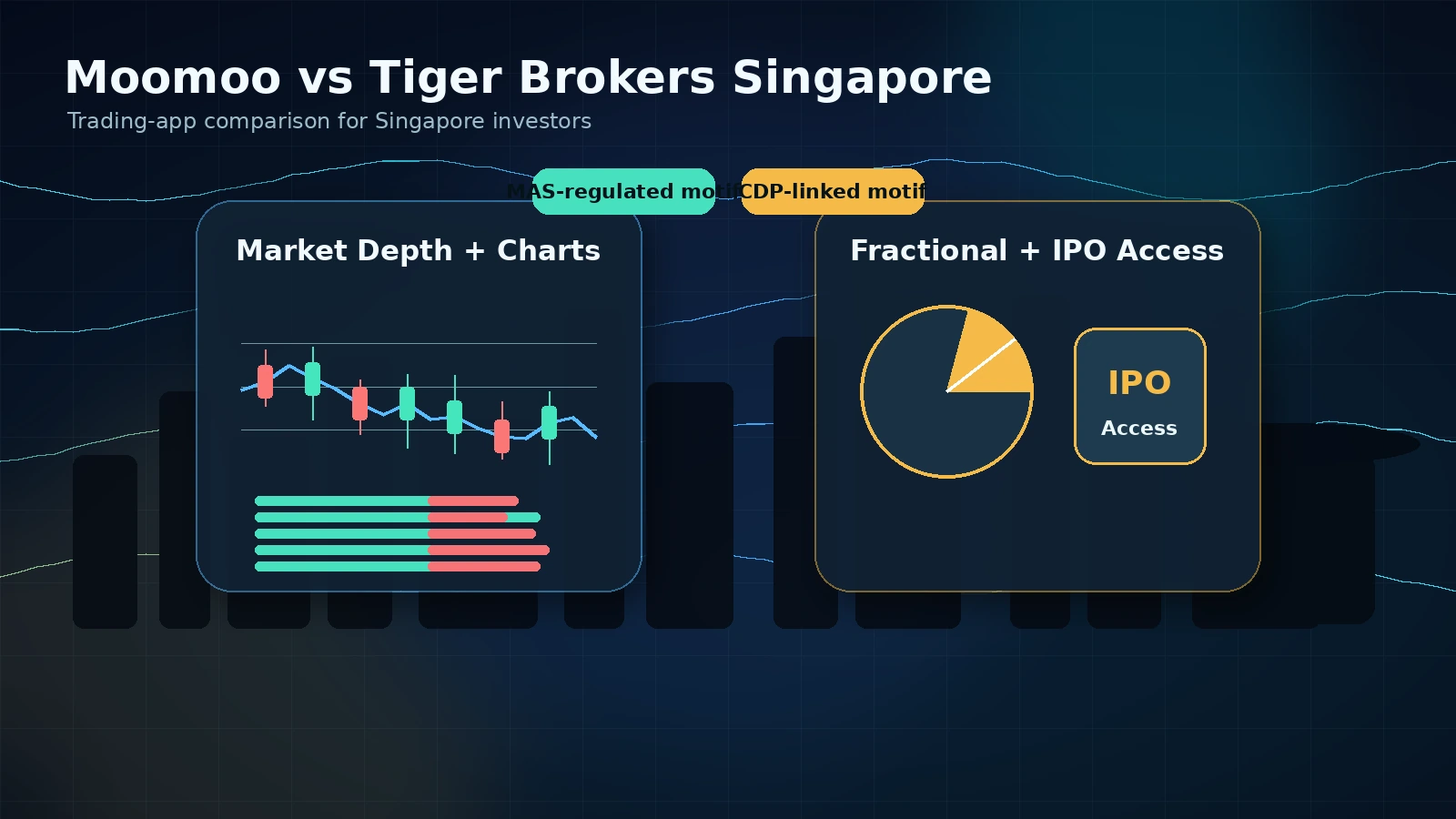
Moomoo and Tiger Brokers are the two fastest-growing retail trading apps for Singapore investors and the two most often Googled side by side. Both are MAS regulated, both have aggressive free-stock and zero-commission promotions, and both offer CDP-linked accounts for SGX shares. The differences sit in the detail — US stock fees, fractional share availability, platform depth, and the type of investor each is built for. This independent comparison breaks down exactly where each platform wins, where they tie, and where neither is the right answer. CFD trading involves significant risk and 74–89% of retail investor accounts lose money. This content is informational and does not constitute financial advice.
Written By
ForexRater Research Team
Data-driven broker comparison · Independently tested · No paid rankings
Reviewed against our published methodology →Reviews represent the editorial opinion of ForexRater and are not personal financial advice.
Two Super Apps Fighting for Singapore
Moomoo and Tiger Brokers have between them captured a remarkable share of Singapore's retail brokerage market in the last four years, largely at the expense of incumbents like POEMS, DBS Vickers, and Saxo. Both apps follow the same playbook: zero or near-zero commissions on US stocks, polished mobile-first UX, free Level 1 (and in Moomoo's case, Level 2) market data, and aggressive customer acquisition through free-stock referral programmes.
Underneath the similar marketing, the two firms are structurally different. Moomoo Singapore is operated by Futu Singapore Pte. Ltd., a subsidiary of Futu Holdings Limited, which is listed on the Nasdaq and partially owned by Tencent. Moomoo's parent group has its origins serving Hong Kong and US-resident Chinese investors, and the app reflects that — sophisticated charting, dense data, an active community feed, and pre-market and after-hours US session access as a headline feature.
Tiger Brokers Singapore is operated by Tiger Brokers (Singapore) Pte. Ltd., the local entity of UP Fintech Holding, which is also Nasdaq-listed. Tiger has a long-standing partnership with Interactive Brokers (IBKR) for execution and custody on certain markets, which gives the platform professional routing on US stocks despite the retail-friendly app. Tiger has historically been stronger on IPO access — particularly Hong Kong and US listings — and on fractional share trading.
Both hold Capital Markets Services licences from the Monetary Authority of Singapore (MAS), which means client monies must be held in segregated trust accounts, and both offer CDP-linked accounts for shares listed on the Singapore Exchange. The MAS regulatory floor is broadly equivalent — the differences are commercial, not protective.
Fees Compared — The Real Cost of Trading
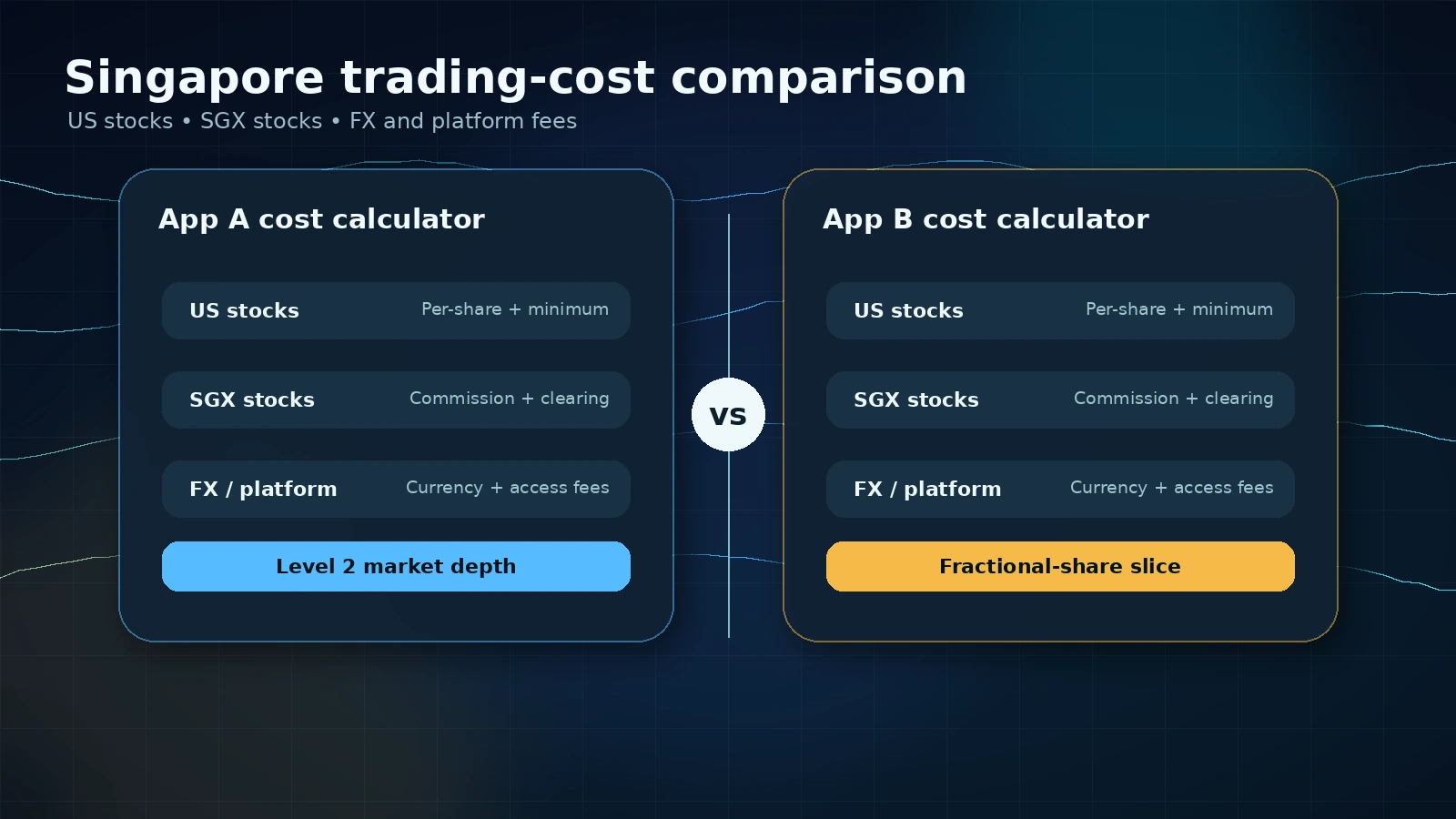
Headline commissions are not the full cost of trading. Both Moomoo and Tiger publish low or zero introductory commissions, but the all-in cost — including platform fees, FX conversion, and SGX clearing — is where the comparison gets interesting.
| Feature | Moomoo SG | Tiger Brokers SG |
|---|---|---|
| MAS Licensed | Yes (Futu Singapore) | Yes (Tiger Brokers SG) |
| Minimum deposit | S$0 | S$0 |
| SGX stock commission | 0.03% (min S$0.99) | 0.06% (min S$1.00) |
| US stock commission | US$0.0049/share | US$0.01/share (min US$1.99) |
| CDP integration | Yes | Yes |
| Fractional US shares | No | Yes |
| Options trading | Yes | Yes |
| Crypto | No | No |
| Level 2 US data | Free (promotional) | Paid add-on |
| Free stock promotion | Ongoing | Periodic |
| Platform | Moomoo App / Desktop | Tiger Trade App |
On US stocks Moomoo is cheaper for almost every retail order size. At US$0.0049 per share with no minimum, a 100-share order costs $0.49 versus Tiger's $1.99 minimum. The gap narrows but does not close at higher volumes — a 1,000-share order is $4.90 at Moomoo and $10 at Tiger.
On SGX stocks Moomoo's 0.03% is half of Tiger's 0.06%, and both apply a small minimum that bites at the smallest trade sizes. For a S$5,000 SGX order, Moomoo charges S$1.50 and Tiger charges S$3.00 — small in absolute terms but a 100% relative gap.
Where Tiger wins on cost is fractional US shares. Buying a tenth of a Berkshire B share, or US$50 of Tesla, is only possible on Tiger. For Singapore investors building a dollar-cost-averaged US portfolio with smaller weekly contributions, this is a structurally different product, not just a cheaper one.
Platform and User Experience
Moomoo is built for traders who want depth. The desktop and mobile apps share the same charting engine — over 50 technical indicators, multi-chart layouts, custom watchlists with conditional alerts, and a community feed where users share trade ideas. Free Level 2 US market depth on the promotional tier is a meaningful differentiator: every other Singapore broker we have reviewed charges a monthly fee for this. Paper trading is built into the app, which is a strong point for newer investors who want to test strategies without funding the account.
Tiger Brokers takes a cleaner, simpler approach. The Tiger Trade app prioritises portfolio view and trade execution over data density. Charting is good but not as deep as Moomoo's. Where Tiger shines is in the options chain interface — easier to navigate than Moomoo's for traders new to options — and in IPO access. Tiger has historically been one of the easiest Singapore platforms to subscribe to Hong Kong and US IPOs from a retail account, which matters for investors who want allocation in new listings.
Who each platform suits. Moomoo is the better fit if you actively trade US stocks, want Level 2 data and tight charting, follow trade community sentiment, or run multi-leg options strategies. Tiger is the better fit if you want to dollar-cost-average into US stocks using fractional shares, are interested in IPO subscriptions, prefer a simpler UI, or already have an Interactive Brokers account and want consistency in execution routing.
Both apps are well-rated on the App Store and Google Play in Singapore. Both are fully translated into English with optional Mandarin. Both support SingPass digital onboarding, which means most accounts can be opened in under 15 minutes.
The genuinely shared weakness is customer support response time during market volatility. Both platforms run lean support teams and queue times stretch on big move days. For investors who want phone-based human support, traditional Singapore brokers — POEMS in particular — still hold an edge.
CDP Integration — Why It Matters for Singapore Investors
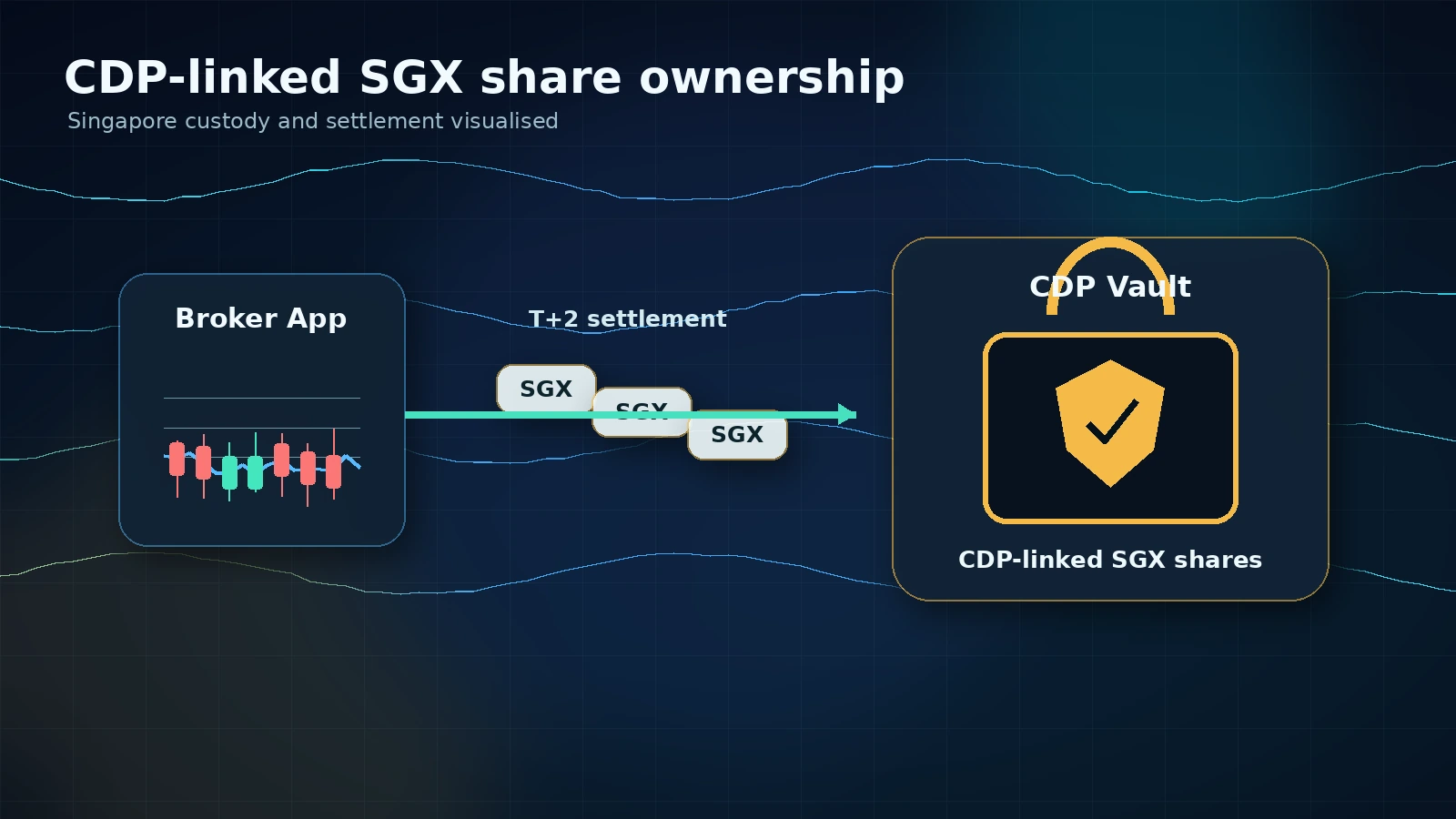
The Central Depository (CDP) is Singapore's central securities depository, operated by Singapore Exchange. When you buy an SGX-listed share through a CDP-linked broker account, the share is registered directly in your name with CDP. The broker is the executing agent, but the legal ownership sits with you, with CDP as custodian.
This matters for one specific reason: if your broker goes bankrupt, shares held in your CDP account are unaffected because they are not on the broker's balance sheet. Under a non-CDP custodian model, shares are held in the broker's name on behalf of clients, and recovery in the event of broker insolvency depends on segregation rules, regulator action, and how clean the broker's records are. The MAS regulatory framework protects custodian-held assets, but recovery is slower and more uncertain than the CDP route.
Both Moomoo Singapore and Tiger Brokers Singapore offer CDP-linked accounts for SGX stocks. Linking is done at account opening or after via SingPass — the process is straightforward and identical in concept on both platforms. Once linked, any SGX share you buy is automatically credited to your CDP account on T+2 settlement.
For US stocks there is no CDP equivalent. US shares purchased through any Singapore broker are held under a custodian arrangement — typically the broker's US clearing partner. Tiger uses Interactive Brokers for routing on some flows; Moomoo uses its parent group's US clearing entity. The protections are MAS segregation rules plus the US-side SIPC coverage where applicable, but the recovery process in an insolvency is more complex than for CDP-held SGX stocks.
Practical takeaway. If a large portion of your portfolio is in SGX blue chips that you intend to hold for years, CDP integration is a meaningful protection and worth using on either platform. For shorter-term US stock trading, the custodian arrangement is industry-standard and not a reason to avoid either broker — but it is a reason to keep concentration risk in mind.
Verdict — Who Should Choose Which
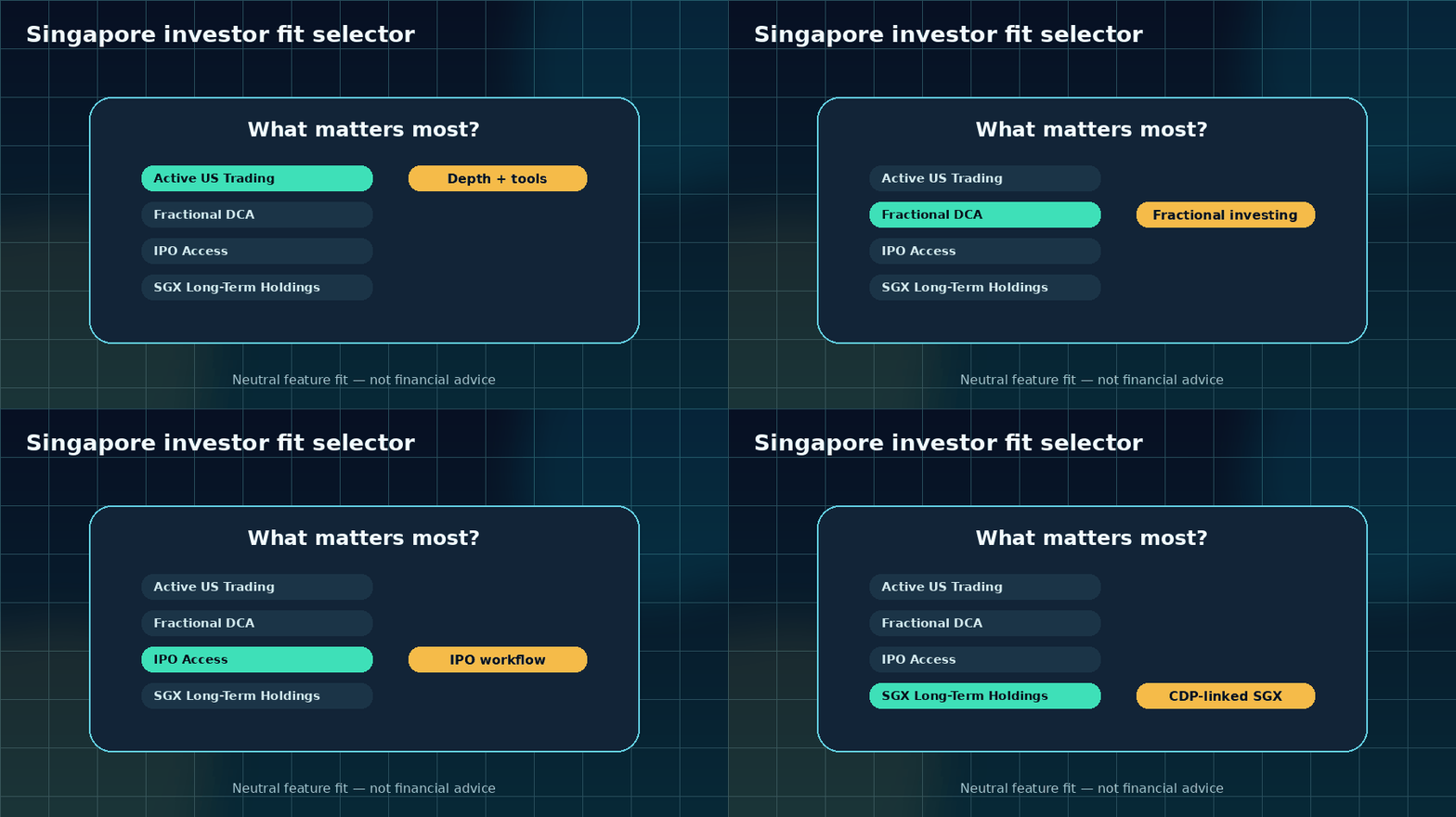
Choose Moomoo if you actively trade US stocks, want free Level 2 data, value a denser charting and analysis suite, and want access to an active investor community. The fee structure is materially cheaper than Tiger for any US order over a few hundred shares, and the promotional tier is genuinely useful for newer traders working out what they want from a platform.
Choose Tiger if you want fractional US shares (the only way to dollar-cost-average into expensive single-name stocks on a small budget), are interested in IPO subscriptions, prefer a cleaner UI, or want consistency with Interactive Brokers' routing. Tiger's SGX commissions are higher, so heavy SGX traders should think twice — but for a US-and-IPO-focused investor it remains the more flexible platform.
Choose neither for forex or CFDs. Neither Moomoo nor Tiger offers retail forex pairs or CFDs in Singapore. If you want to trade currencies, indices, or commodity CFDs from a Singapore base, the better-suited regulated alternatives are IC Markets for ECN execution, Vantage for a broader instrument mix with copy trading, or VT Markets (see our VT Markets review) as a mid-tier alternative. See our full Singapore broker comparison for the ranked list.
Many serious Singapore investors end up running both Moomoo and Tiger — Moomoo for active US trading, Tiger for fractional dollar-cost averaging and IPO access. Account opening is free on both, so the cost of running parallel accounts is operational rather than financial.
Risk warning. All investing involves risk including the potential loss of capital. CFD trading specifically involves significant risk and 74–89% of retail investor accounts lose money. This article is informational and does not constitute financial advice or a recommendation to use any specific broker.
📖 Key Terms — Forex Glossary
Not sure about a term?Browse our full Forex Glossary →
Frequently Asked Questions
Expert Answers to Common Queries