Best CFD & Forex Brokers in Switzerland 2026
Switzerland's financial reputation is unmatched — and its retail trading environment reflects that. With no capital gains tax for private investors, access to premium ECN brokers, and robust FINMA oversight, Swiss traders operate in one of the world's most sophisticated financial ecosystems. This guide compares the four best brokers for Switzerland-based traders in 2026 on spreads, CHF pair quality, regulation, and Swiss market conditions.
Written By
ForexRater Research Team
Data-driven broker comparison · Independently tested · No paid rankings
Reviewed against our published methodology →Reviews represent the editorial opinion of ForexRater and are not personal financial advice.
Forex & CFD Trading in Switzerland — The FINMA Landscape
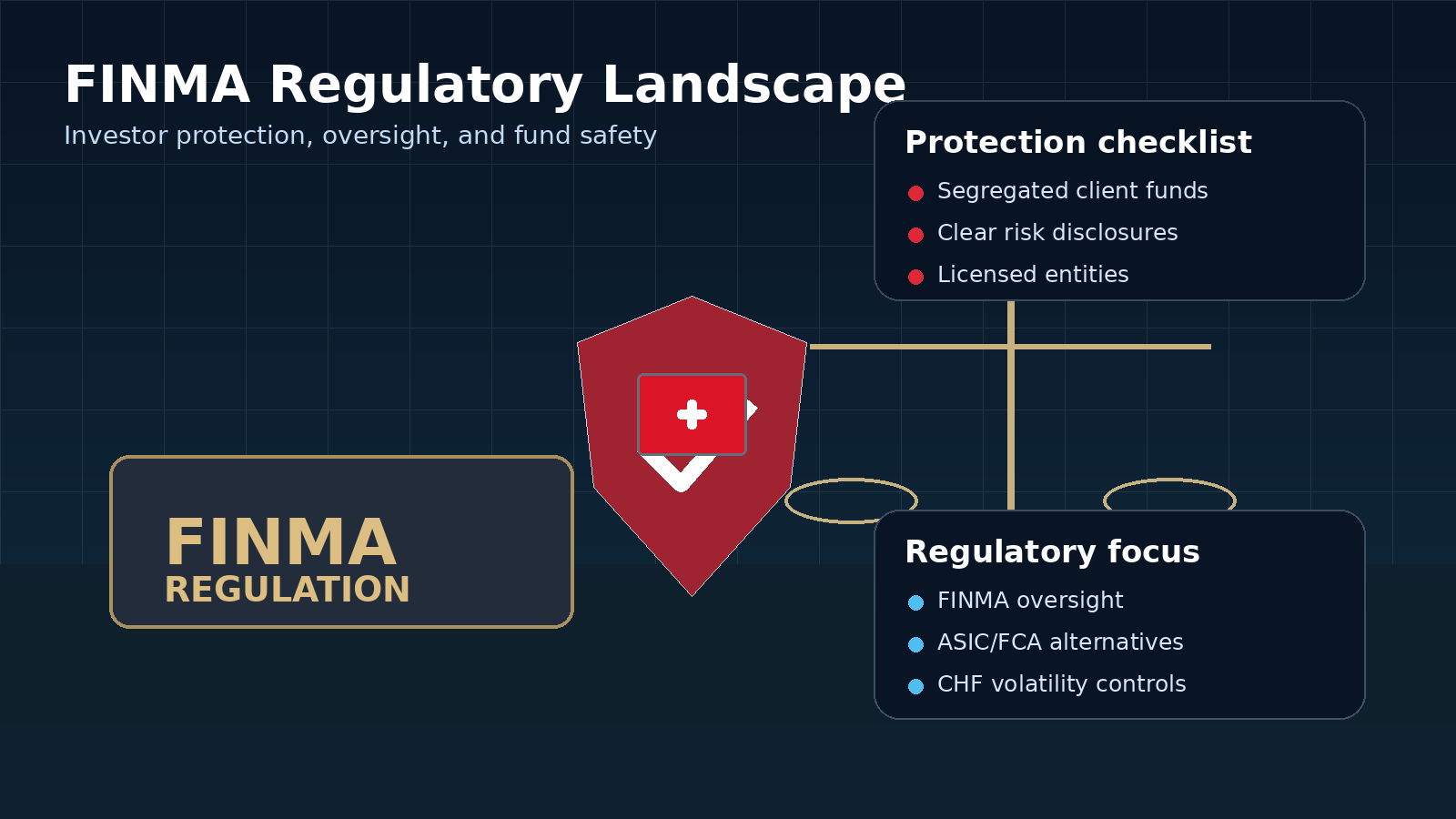
Switzerland is home to one of the world's most prestigious financial regulatory environments. The Swiss Financial Market Supervisory Authority (FINMA) oversees all financial services activity in the country, including forex and CFD brokers. FINMA is widely regarded as one of the most rigorous regulators globally — comparable to the FCA and ASIC — making Switzerland an attractive domicile for sophisticated trading clients.
Swiss-based retail traders benefit from the country's political neutrality, banking secrecy traditions, and a well-developed financial infrastructure. The Swiss franc (CHF) is classed as a safe-haven currency, and USD/CHF, EUR/CHF, and GBP/CHF are among the most actively traded pairs for Swiss retail accounts. The 2015 SNB shock — when the Swiss National Bank removed the EUR/CHF 1.20 floor — remains a cautionary tale about CHF volatility risk.
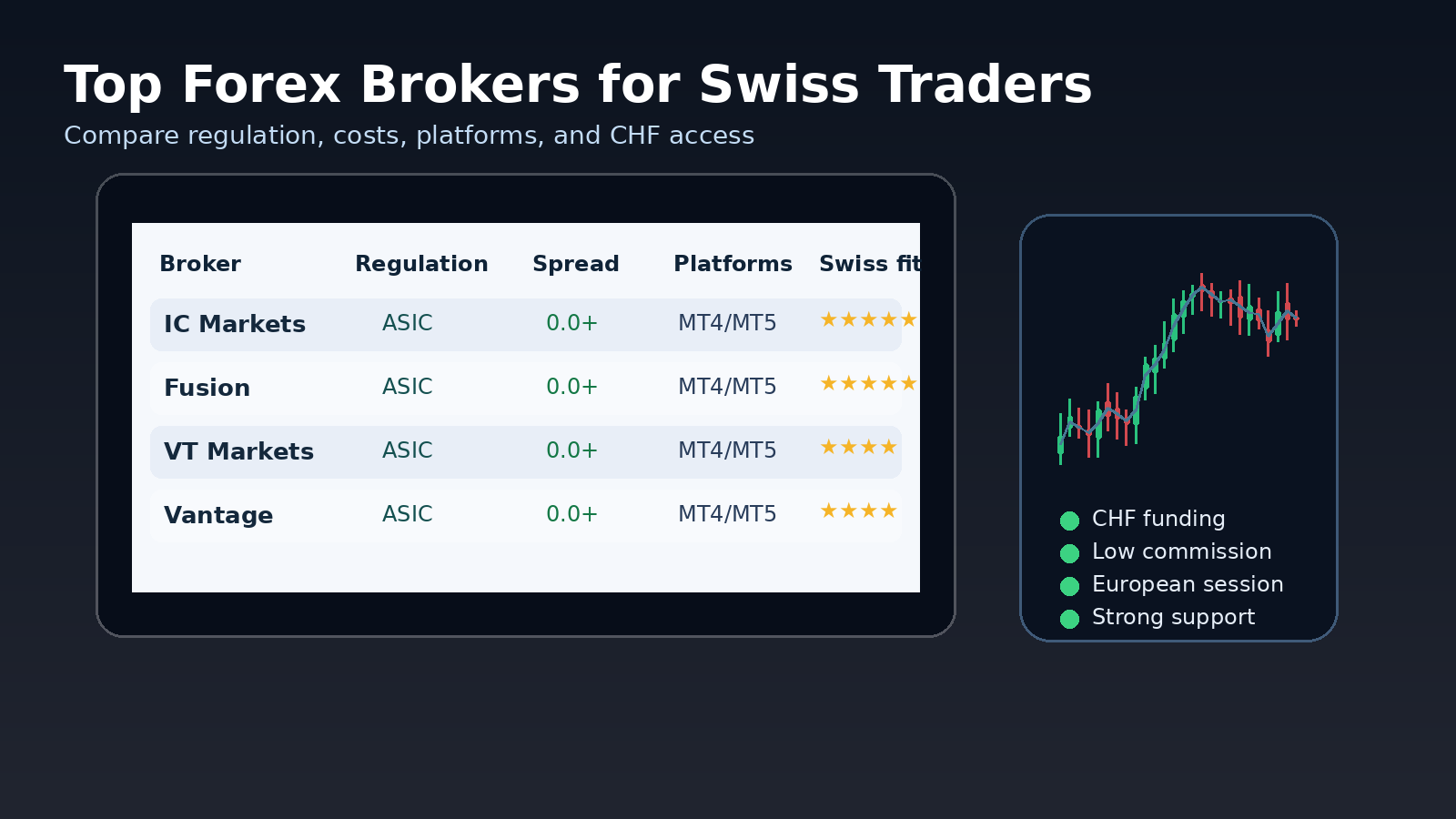
Most Swiss retail traders access brokers licensed by ASIC (Australia) or the FCA (UK) rather than FINMA directly, as FINMA-licensed retail FX brokers are fewer in number. IC Markets, Fusion Markets, VT Markets, and Vantage are all accessible to Swiss residents under their respective ASIC entities and represent the top ECN options for 2026.
Top 4 Brokers for Swiss Traders in 2026
1. IC Markets — Best Overall for Swiss Traders
IC Markets is ASIC-regulated and fully accessible to Swiss residents. EUR/USD raw spreads from 0.0 pips with a $3.50 commission per side. The broker maintains server infrastructure in Equinix NY4 (New York) and LD4 (London), ensuring reliable European session execution quality for Swiss-based traders. MT4, MT5, and cTrader are all supported. Minimum deposit: $200. IC Markets is the preferred choice for Swiss scalpers and algorithmic traders.
2. Fusion Markets — Lowest All-In Cost
Fusion Markets offers the lowest commissions of any major retail broker — $2.25 per side on its ZERO account — with EUR/USD raw spreads from 0.0 pips. There is no minimum deposit on the ZERO account, making it accessible for Swiss traders who want to test execution quality before scaling up. MT4 and MT5 supported. Fusion is ASIC-regulated and particularly popular with Swiss traders focused on minimising friction costs on high-volume strategies.
3. VT Markets — Strong European Session Liquidity
VT Markets (VT Global) is ASIC-regulated and offers competitive raw ECN spreads from 0.0 pips on its ECN account. EUR/CHF spreads are particularly competitive during the European session due to VT Markets' deep liquidity pool routing. MT4 and MT5 are supported. VT Markets provides CHF-friendly funding options including bank wire transfer. Minimum deposit: $200.
4. Vantage — Best Platform Flexibility
Vantage is ASIC-regulated with additional FCA, FSCA, and CIMA licences. Minimum deposit of $50 makes it one of the most accessible ECN brokers for Swiss retail traders. Vantage supports MT4, MT5, and ProTrader (TradingView-integrated). EUR/USD raw spread from 0.0 pips with $3.00 commission per side. A strong choice for Swiss traders who prioritize TradingView integration and platform range.
CHF Pairs and Swiss Market Conditions
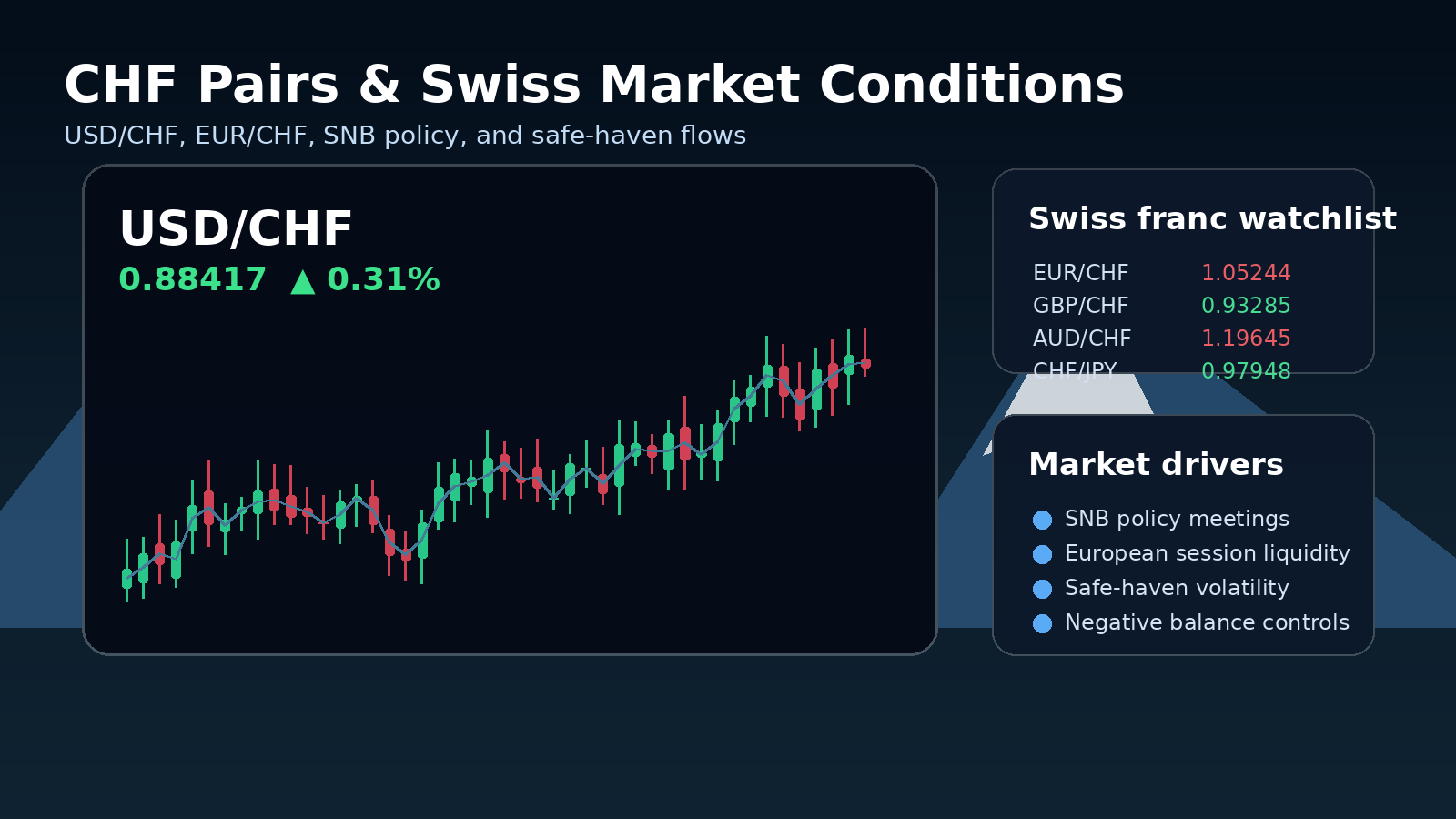
The Swiss franc is among the most actively traded safe-haven currencies globally. EUR/CHF is the highest-volume CHF pair due to the close economic relationship between Switzerland and the Eurozone — over 40% of Swiss exports go to EU member states. USD/CHF is the second most traded pair and is heavily influenced by SNB interest rate policy and broader USD sentiment.
CHF-denominated pairs can exhibit extreme volatility during SNB policy announcements. The January 2015 event — when SNB unexpectedly removed the EUR/CHF floor — saw EUR/CHF drop over 2,000 pips in minutes, causing significant losses at brokers that lacked adequate margin controls. All four recommended brokers now maintain negative balance protection as a standard offering.
For Swiss traders during the European session (08:00–17:00 CET), IC Markets and VT Markets consistently deliver the tightest EUR/CHF spreads — typically 2–5 pips during liquid periods. During SNB announcement windows, spreads widen considerably across all brokers. GBP/CHF and AUD/CHF are also available on all four platforms with raw spread pricing.
Tax Treatment of Forex Profits in Switzerland
Switzerland's tax treatment of forex trading is nuanced and depends on whether trading is classified as private wealth management (not taxable) or professional trading (taxable as self-employment income). Swiss federal and cantonal tax authorities apply several criteria to distinguish the two: frequency of trades, use of leverage, proportion of income from trading, and holding periods.
For private investors who trade occasionally and primarily manage existing wealth, profits from forex and CFD trading are generally treated as tax-free capital gains. Switzerland does not levy a federal capital gains tax on private assets. However, wealth tax applies to the value of trading accounts — this varies by canton and is typically between 0.1% and 1% per year on net assets.
Professional traders who derive their primary or significant income from forex trading are subject to cantonal and federal income tax on profits, which can range from 20–45% depending on the canton and income level. Zurich, Geneva, and Zug have notably different tax rates. Swiss traders with significant trading activity should consult a Swiss-qualified tax advisor (Steuerberater) for personalised guidance.
SNB Policy and Its Impact on Forex Traders
The Swiss National Bank (SNB) meets quarterly to review monetary policy, with meetings typically scheduled in March, June, September, and December. SNB announcements can trigger substantial moves in CHF pairs — particularly EUR/CHF, USD/CHF, and GBP/CHF — as the SNB is known for interventionist policy including direct FX market intervention to manage CHF strength.
Swiss traders should monitor SNB sight deposit data (published weekly), which provides early signals of SNB FX intervention activity. A sustained increase in sight deposits historically indicates the SNB is selling CHF to weaken the currency. All four recommended brokers provide economic calendar tools that highlight SNB meeting dates.
The SNB's negative interest rate era (2015–2022) significantly shaped CHF dynamics. With rates now normalised, CHF has reverted to its traditional role as a safe-haven currency that strengthens during global risk-off periods. Swiss traders should factor this correlation into any multi-currency portfolio.
Best CFD & Forex Brokers in Switzerland 2026 Quiz
Test your understanding of the concepts covered in this masterclass.
1.Which regulator oversees financial markets in Switzerland?
2.Are forex trading profits taxable in Switzerland for private investors?
3.What event in January 2015 created extreme CHF volatility?
4.Which broker offers the lowest per-side commission among the top 4 for Swiss traders?
📖 Key Terms — Forex Glossary
Not sure about a term?Browse our full Forex Glossary →
Frequently Asked Questions
Expert Answers to Common Queries
Is forex trading legal in Switzerland?
Does Switzerland have a capital gains tax on forex profits?
Which CHF pairs have the lowest spreads?
How does SNB policy affect forex traders?
What is the minimum deposit for the top brokers?
Testing Methodology
Spread figures shown are broker-published and sampled by our Observatory; see How We Test for methodology. Regulation data verified against FINMA, ASIC, and FCA public registers. Tax guidance sourced from Swiss Federal Tax Administration (ESTV) official publications and is general in nature — consult a Swiss-qualified tax advisor (Steuerberater) for personal advice.