Best CFD & Forex Brokers in Japan 2026

Japan hosts the world's largest retail forex market — a testament to the depth of engagement Japanese traders have with currency markets. For Japanese investors looking to trade Kioxia Holdings (TSE: 285A) specifically, see our dedicated guide on how to buy Kioxia stock.
Japan hosts the world's largest retail forex market — a testament to the depth of engagement Japanese traders have with currency markets. With JPY as the third most traded currency globally, USD/JPY consistently ranking as the world's second most liquid FX pair, and a unique regulatory environment under the FSA, Japan represents one of the most sophisticated retail trading ecosystems on the planet. This guide compares the best brokers for Japan-based traders in 2026 on execution quality, JPY pair conditions, and tax implications.
Written By
ForexRater Research Team
Data-driven broker comparison · Independently tested · No paid rankings
Reviewed against our published methodology →Reviews represent the editorial opinion of ForexRater and are not personal financial advice.
Forex & CFD Trading in Japan — FSA Regulation and the World's Largest Retail FX Market
Japan is the largest retail forex market in the world by volume. Japanese retail traders — often referred to as 'Mrs Watanabe' in market parlance — account for a substantial share of global retail FX flows, particularly in JPY pairs during the Tokyo session. The market is regulated by the Financial Services Agency (FSA), one of the strictest regulators globally when it comes to retail leverage and investor protection.
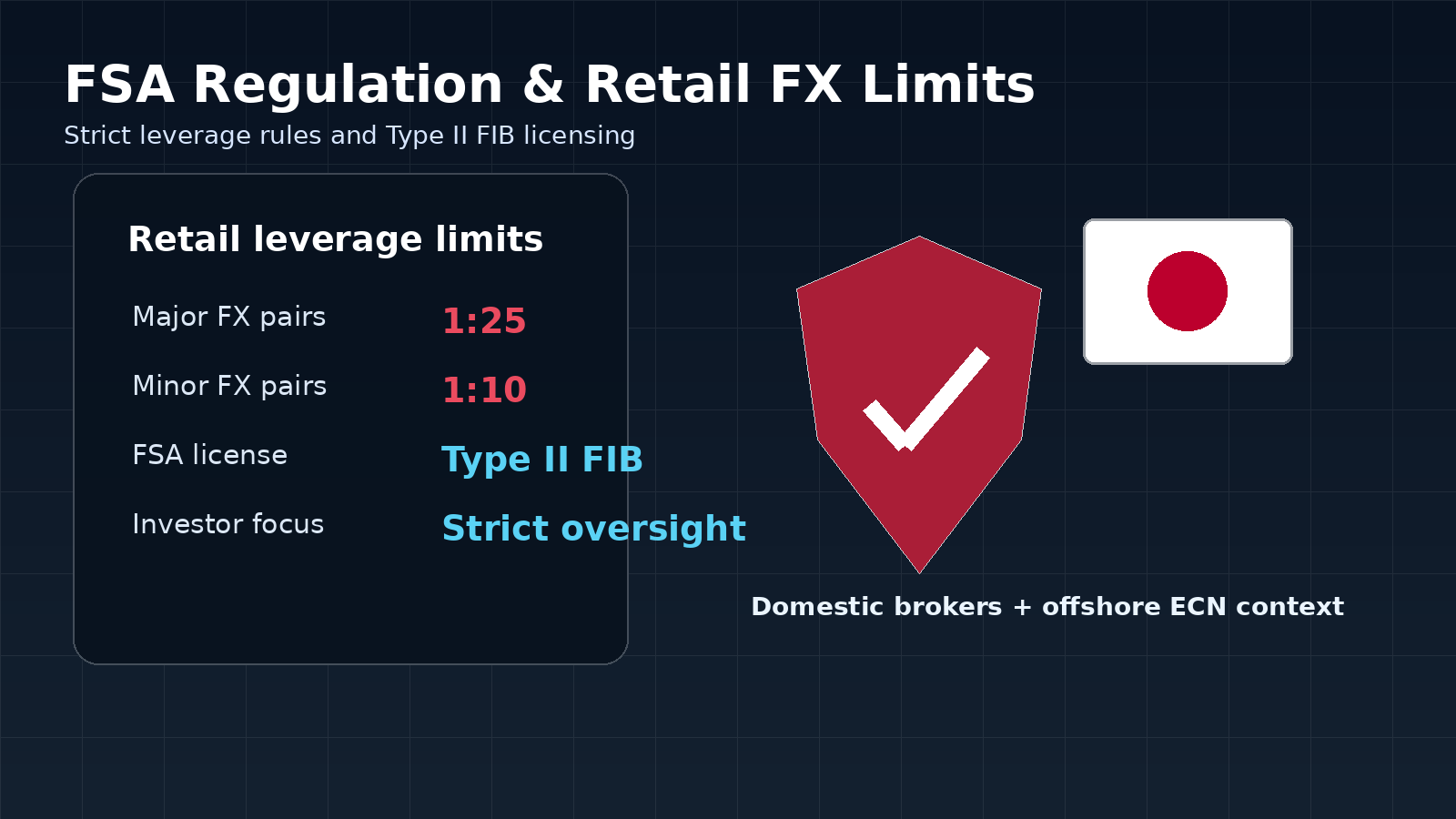
The FSA imposes a flat maximum leverage limit of 1:25 for all retail forex pairs — significantly more restrictive than ASIC's 1:30 or the EU's 1:30 limits. All forex brokers serving Japanese residents must hold an FSA Type I Financial Instruments Business (FIB) licence. This results in a largely domestic broker ecosystem — international brokers such as IC Markets, Fusion Markets, and Vantage do not hold FSA licences and technically cannot actively market to Japanese residents.
In practice, many sophisticated Japanese traders use offshore ASIC-regulated brokers via their global entities, accepting the legal ambiguity in exchange for better execution conditions and higher leverage. For traders who prefer regulated domestic options, local FSA-licensed brokers include GMO Click Securities, DMM FX, and Gaitame.com. This guide covers both the international ECN options and the domestic context.
Top 4 International ECN Brokers Used by Japanese Traders
1. IC Markets — Best Execution for Asian Session
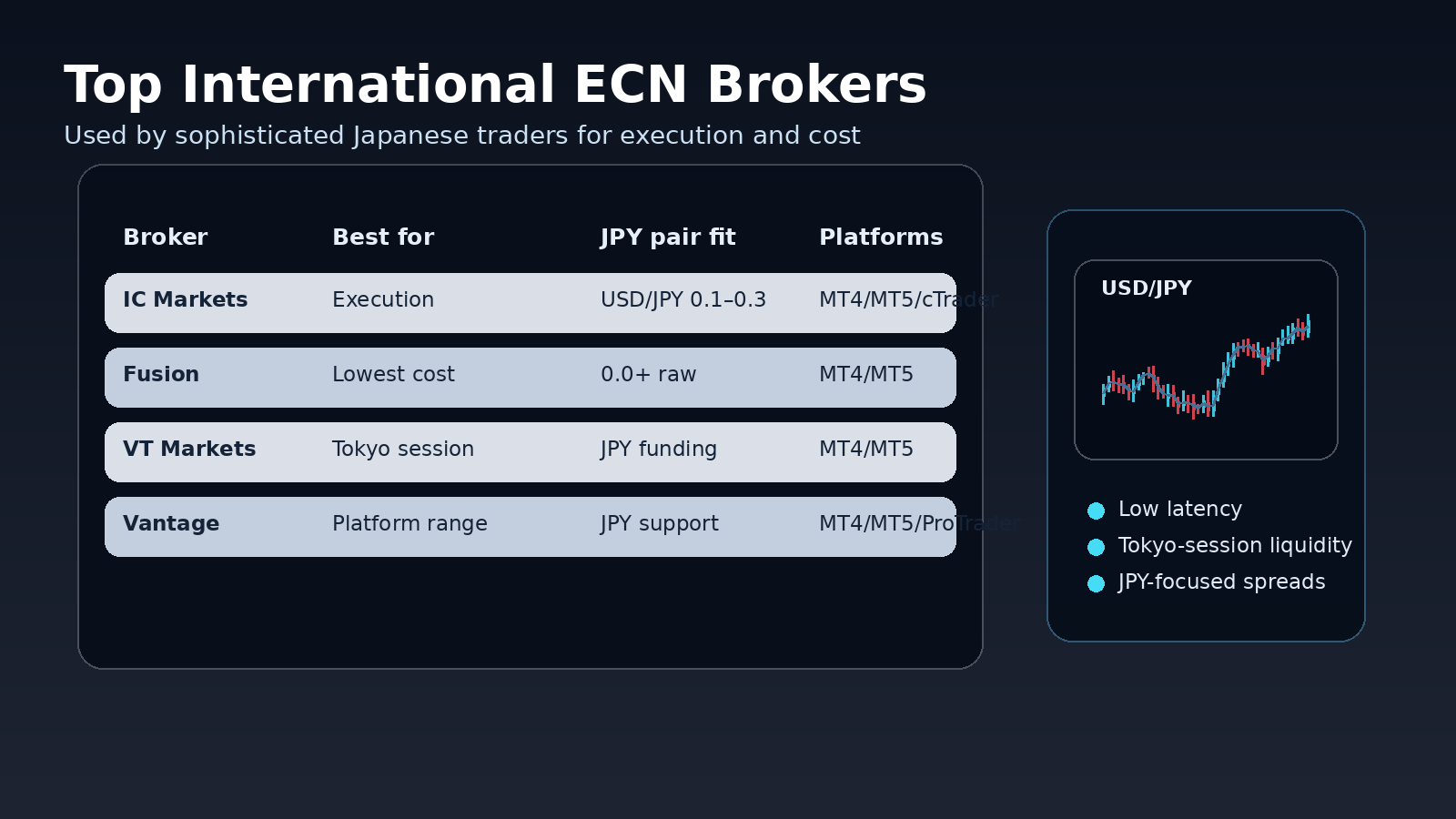
IC Markets maintains MT4/MT5 server infrastructure co-located in Equinix NY4 (New York) and LD4 (London), with lower latency during the Tokyo session than many Japanese domestic brokers. EUR/USD raw spreads from 0.0 pips with a $3.50 commission per side. USD/JPY spreads average 0.1–0.3 pips on the raw account. IC Markets is ASIC-regulated and widely used by professional Japanese traders who require professional ECN execution.
2. Fusion Markets — Lowest Cost for JPY Pair Trading
Fusion Markets offers $2.25 per side commission on its ZERO account — the lowest of any major broker. USD/JPY raw spreads from 0.0 pips. No minimum deposit. MT4 and MT5 supported. Fusion is particularly cost-effective for Japanese traders running scalping or high-frequency strategies on JPY pairs, where fractional pip savings compound significantly at volume.
3. VT Markets — Tokyo Session Optimised
VT Markets has strong Southeast Asian and East Asian client infrastructure. ECN spreads from 0.0 pips on major pairs, including USD/JPY, EUR/JPY, and GBP/JPY. VT Markets supports MT4 and MT5 and offers JPY-denominated funding via bank transfer. Particularly popular with Japanese traders seeking a broker with regional market knowledge.
4. Vantage — Best Platform Range
Vantage is ASIC, FCA, and FSCA regulated. Minimum deposit $50. MT4, MT5, and ProTrader (TradingView-integrated) supported. EUR/USD raw spread from 0.0 pips with $3.00 commission per side. USD/JPY available with tight raw spreads. Vantage has Japanese-language customer support resources, making it accessible for traders less comfortable with English-only interfaces.
JPY Pairs and Tokyo Session Trading
Japan's currency — the Japanese yen (JPY) — is the third most traded currency in the world by daily volume. USD/JPY is the second most liquid currency pair globally, behind only EUR/USD. EUR/JPY, GBP/JPY, and AUD/JPY are also among the most actively traded crosses. JPY pairs are known for lower spreads during the Tokyo session (00:00–08:00 UTC) compared to European or New York sessions.
The Bank of Japan (BoJ) has historically maintained ultra-loose monetary policy, including yield curve control (YCC) — a policy of targeting the 10-year JGB yield at near-zero levels. BoJ policy pivots generate some of the most significant JPY moves: the Bank of Japan's July 2024 rate hike and the subsequent unwind of yen carry trades saw USD/JPY drop over 800 pips in early August 2024. BoJ meetings and press conferences are critical calendar events for JPY pair traders.
USD/JPY is the most influential pair for understanding JPY dynamics. The interest rate differential between the US Federal Reserve and the Bank of Japan drives the dominant trend. Carry trade dynamics — borrowing in low-rate JPY to invest in higher-yielding assets — create self-reinforcing trends in JPY pairs that can reverse violently when risk sentiment deteriorates.
Tax Treatment of Forex Profits in Japan
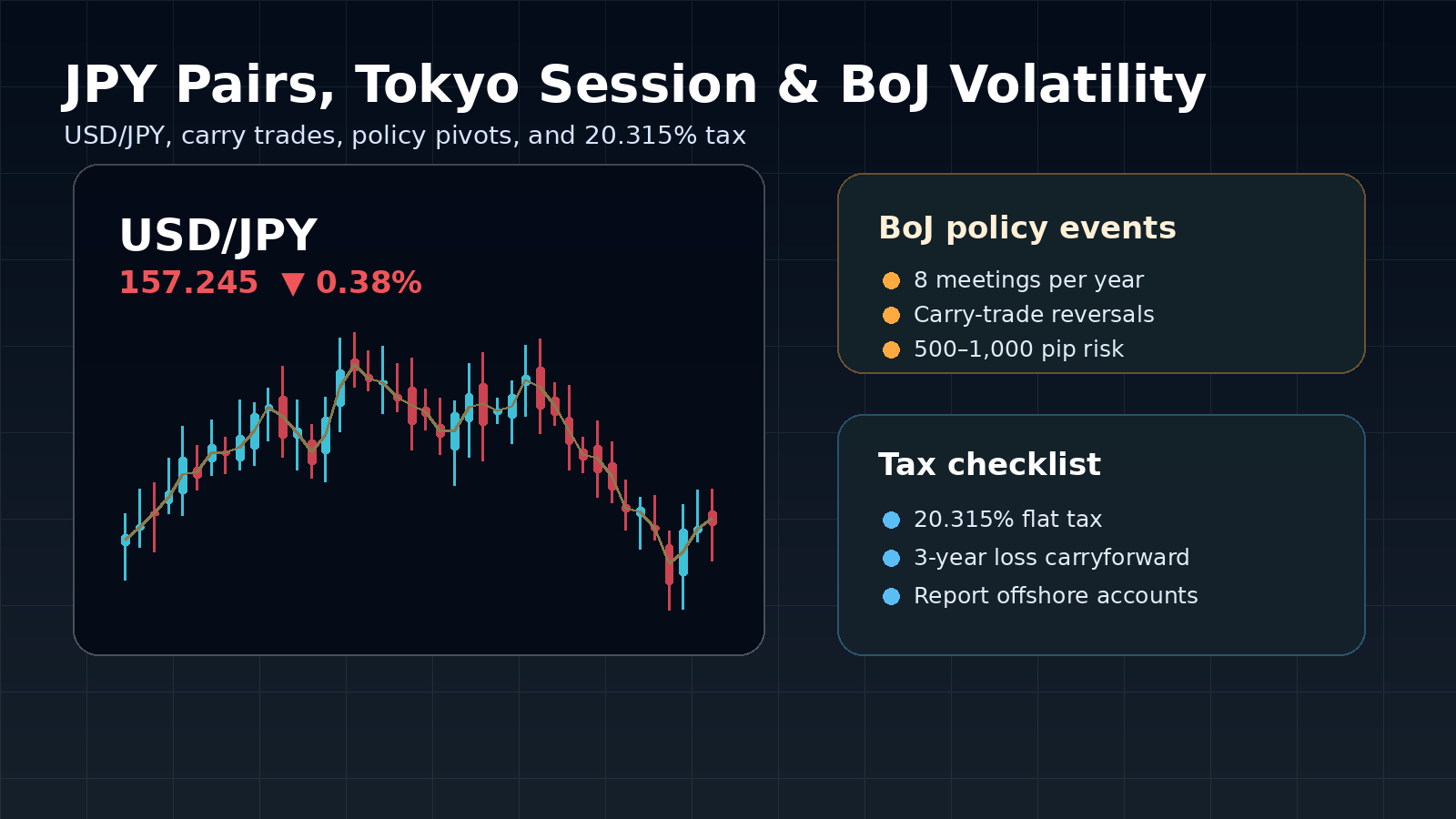
Japan taxes forex and CFD trading profits at 20.315% — comprising 15% national income tax, 5% prefectural/municipal tax, and 0.315% reconstruction special income tax. This flat rate applies to all classified financial instruments under Japan's 'separate self-assessment taxation' (bunri kazei) regime, which treats forex profits as a distinct category from regular employment income.
Japanese traders benefit from a three-year loss carryforward provision — losses from forex and CFD trading can be carried forward for up to three years to offset future trading profits. This is a significant advantage compared to some jurisdictions where losses cannot be carried forward. Traders must file a separate income tax return (kakutei shinkoku) to claim this benefit.
Profits from offshore broker accounts must be reported in Japan. The National Tax Agency (NTA) has increasingly focused on offshore financial account compliance, particularly accounts above JPY 50 million (approximately $330,000) which trigger mandatory disclosure. Japanese traders using ASIC-regulated offshore brokers should maintain detailed records of all transactions for tax purposes.
Bank of Japan Policy and JPY Volatility
The Bank of Japan's decade-long ultra-loose monetary policy under Governor Haruhiko Kuroda (2013–2023) created sustained JPY weakness, with USD/JPY rising from approximately 78 to 152 over the period. Under Governor Kazuo Ueda (appointed 2023), the BoJ began normalising policy — ending negative interest rates in March 2024 and raising rates for the first time since 2007.
For traders, BoJ policy normalisation has transformed JPY from a predictable carry trade funding currency into a more dynamic asset. USD/JPY volatility has increased significantly since 2023, with moves of 500–1,000 pips now occurring on BoJ announcement days. The BoJ meets eight times per year, and all four recommended brokers' economic calendars highlight BoJ meeting dates with the highest importance rating.
JPY also functions as a safe-haven currency during global risk-off events — similar to CHF. During periods of market stress (geopolitical crises, equity market selloffs), JPY typically strengthens as carry trades are unwound. Japanese traders should monitor both BoJ fundamentals and global risk sentiment to anticipate JPY direction.
Best CFD & Forex Brokers in Japan 2026 Quiz
Test your understanding of the concepts covered in this masterclass.
1.Which regulator oversees forex brokers in Japan?
2.What is the tax rate on forex profits in Japan?
3.What is the maximum leverage for retail forex traders in Japan?
4.Which event significantly impacted USD/JPY in March 2024?
📖 Key Terms — Forex Glossary
Not sure about a term?Browse our full Forex Glossary →
Frequently Asked Questions
Expert Answers to Common Queries
Is forex trading legal in Japan?
How are forex profits taxed in Japan?
What is 'Mrs Watanabe' in forex trading?
What drives USD/JPY movements?
Which broker is best for Tokyo session JPY pair trading?
Related Article
How to Buy Kioxia Stock (285A) — Best Brokers for Japanese Investors 2026
Kioxia Holdings (TSE: 285A) is Japan's leading NAND flash memory manufacturer. Find out which brokers offer Kioxia stock trading with the lowest fees and best execution.
Read Article →Testing Methodology
Spread figures shown are broker-published and sampled by our Observatory; see How We Test for methodology. Regulation data verified against FSA Japan, ASIC, and FCA public registers. Tax guidance sourced from Japan's National Tax Agency (NTA) official publications and is general in nature — consult a Japanese-qualified tax advisor (zeirishi) for personal advice.