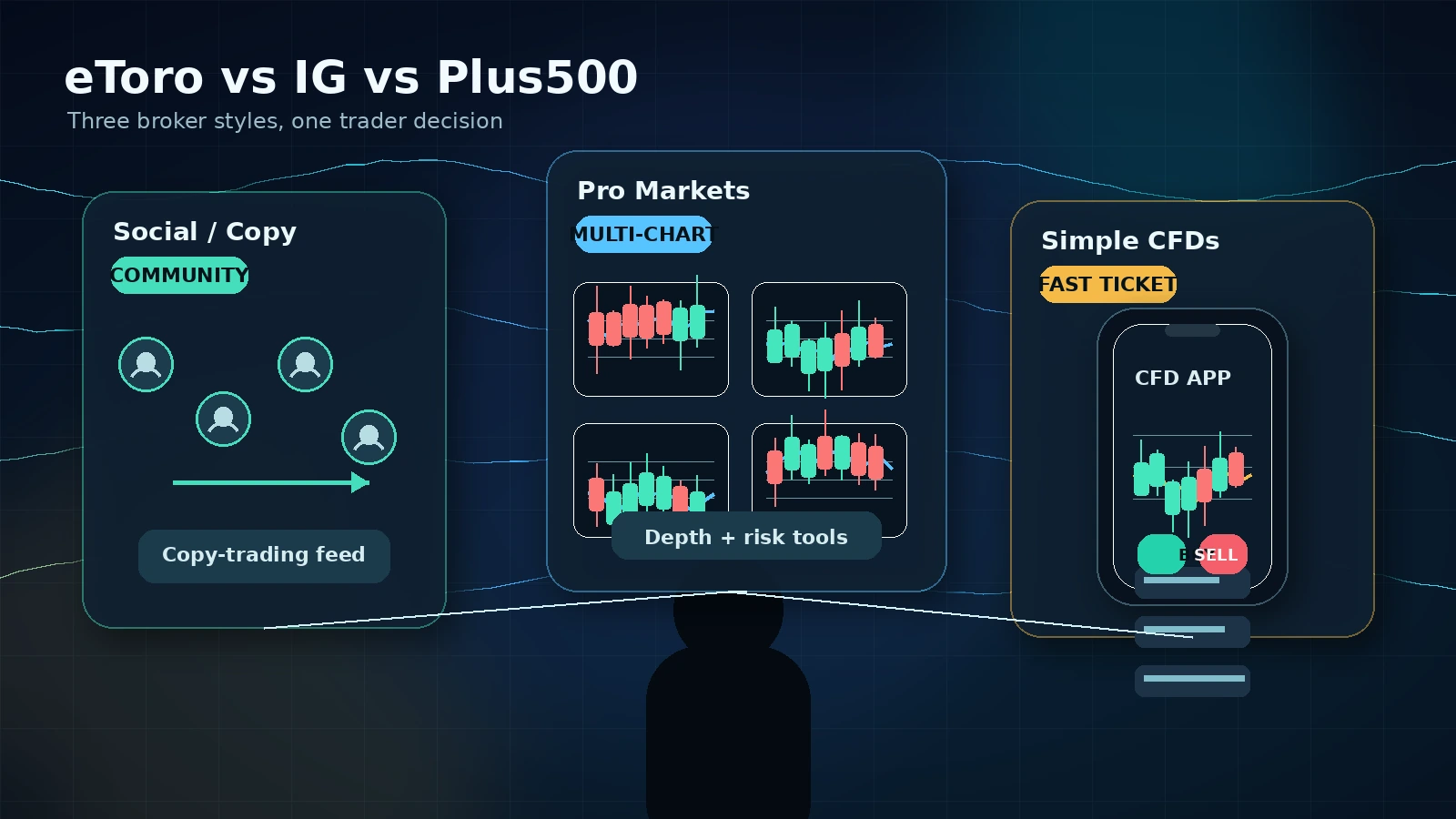
eToro, IG Group and Plus500 are three of the most-Googled retail trading brands in the world — and they are not, despite frequent surface-level comparisons, the same kind of product. eToro is a social-and-copy-trading network with real stock ownership bolted on. IG is the oldest CFD provider in the industry with a deeply professional toolset. Plus500 is a pure CFD platform with the simplest interface of the three and no real stock ownership at all. This independent 2026 comparison breaks down fees, platforms, regulation, and which broker fits which type of trader — including who should consider none of them. CFD trading involves significant risk and 74–89% of retail investor accounts lose money. This content is informational and does not constitute financial advice.
Written By
ForexRater Research Team
Data-driven broker comparison · Independently tested · No paid rankings
Reviewed against our published methodology →Reviews represent the editorial opinion of ForexRater and are not personal financial advice.
Three Giants, Three Very Different Approaches
eToro launched in 2007 and pioneered the social-trading category — the now-familiar feed of trade ideas, the ability to copy another trader's portfolio automatically, and the gradual addition of real stocks, ETFs, and real cryptocurrency alongside the original CFD product. eToro reports more than 30 million registered users globally and is publicly listed. The platform is built explicitly around accessibility for newer investors, with CopyTrader and the virtual portfolio as headline features.
IG Group is the oldest name in the comparison. Founded in 1974 as IG Index, it remains the largest CFD provider in the UK and one of the most respected globally. IG is FCA, ASIC and MAS regulated, listed on the London Stock Exchange, and runs one of the deepest product catalogues in retail trading — over 17,000 markets including direct market access (DMA) on shares, a full share-dealing arm, an ISA wrapper for UK clients, and ProRealTime charting integration. IG is generally where serious retail traders end up when they outgrow simpler platforms.
Plus500 is the pure CFD specialist. Listed on the London Stock Exchange and FCA, ASIC and CySEC regulated, Plus500 offers a single proprietary trading app and no real stock ownership. The pitch is simplicity — minimal options, clean UI, fast onboarding — and the product is genuinely simple in a way the other two are not. Plus500 publishes its retail loss rates prominently as required by ESMA rules.
All three are regulated brokers in good standing in multiple jurisdictions. The comparison is not about safety; it is about cost structure and fit. The cheapest of the three for an active trader is not the cheapest of the three for a beginner copying a portfolio, and the right answer depends sharply on what you actually do with the account.
Fees and Costs — Side by Side
The headline numbers below are the published rack rates for each broker as of mid-2026. All three offer occasional promotions and reduced spreads for higher-volume tiers — the table reflects the standard retail account on each platform.
| Feature | eToro | IG Group | Plus500 |
|---|---|---|---|
| Regulation | FCA, CySEC, ASIC | FCA, ASIC, MAS | FCA, ASIC, CySEC |
| Minimum deposit | $50 | £250 | $100 |
| EUR/USD spread (typical) | 1.0 pip | 0.6 pip | Variable (wider) |
| FX commission | $0 | $0 (DMA extra) | $0 |
| Real stock ownership | Yes | Yes (Share Dealing) | No |
| CFDs available | Yes | Yes | Yes |
| Copy trading | Yes (CopyTrader) | No | No |
| Crypto | Real coins + CFD | CFD only | CFD only |
| Withdrawal fee | $5 | £0 | £0 |
| Inactivity fee | $10/month after 12 months | £12/month after 24 months | $10/month after 3 months |
| Platform | Proprietary web/app | Web, L2 Dealer, MT4, ProRealTime | Proprietary web/app |
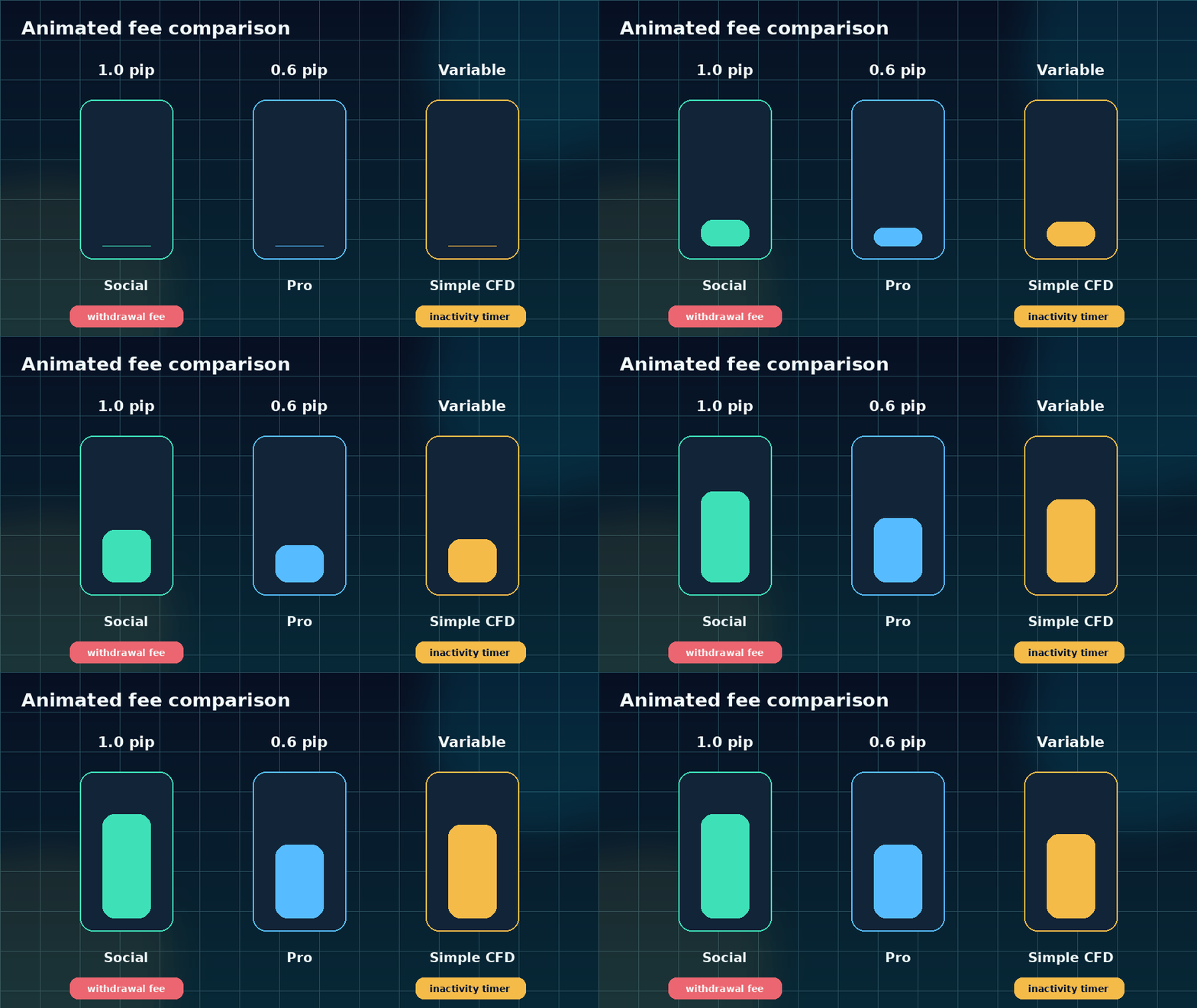
Three things worth highlighting from the table. First, IG has the tightest spreads on majors — 0.6 pips on EUR/USD is competitive against most of the retail market. Second, eToro's $5 withdrawal fee is unusual at this size of broker and adds up if you withdraw frequently; both IG and Plus500 charge nothing on standard withdrawals. Third, Plus500's three-month inactivity threshold is the shortest of the three by a wide margin — if you open the account, fund it, and then leave it idle for a quarter, you start losing money to fees.
The fee table also hides one structural cost: eToro and Plus500 are not ECN brokers and the spread is the all-in cost — there is no commission to find or compare. IG offers both spread-based pricing and DMA execution with explicit commissions for clients who want it. For high-volume traders, the DMA route on IG is often the cheapest of any of the three.
Platform Quality and User Experience
eToro is the most beginner-friendly platform of the three by a long way. The default view is a portfolio screen with a social feed below it. CopyTrader lets you allocate a portion of your account to mirror another trader's positions in real time — a feature with serious caveats around past performance and concentration risk, but a genuine differentiator for users who want a passive route into markets. The virtual portfolio gives users $100,000 of paper money to test strategies. The platform is light on advanced charting and analysis tools, which is consistent with the audience it targets.
IG sits at the opposite end of the spectrum. The standard web platform is competent. The L2 Dealer platform — IG's direct market access front end — is one of the most professional retail-accessible trading interfaces in the industry, with full level 2 order book depth on UK and major European shares, and direct routing to exchange. IG also integrates ProRealTime charting natively, which gives serious technical traders the same toolset used in many institutional shops. The trade-off is complexity: IG is not the easiest platform to learn, and the breadth of products and account types can be overwhelming for newer users.
Plus500's platform is the simplest interface in CFD trading. The mobile and web apps share a near-identical UI with a small set of high-quality features and almost no clutter. Charting is adequate for the level of trader the platform attracts but is not the reason to use Plus500 — the reason to use Plus500 is that you want to take simple directional CFD positions without thinking about MT4, ECN routing, or DMA. As a clean, no-friction CFD interface for casual traders, it is hard to beat. As a tool for serious analysis, it is hard to recommend.
Mobile apps: eToro's app is rated highest across the three on user-experience surveys we have seen, particularly among newer investors. IG's app has the deepest data — full charting, full economic calendar, full alerts — but a steeper learning curve. Plus500's app is the cleanest interface but the most limited in analytical depth.
Customer support is broadly equivalent across all three — chat-first, slower than incumbents on the phone, English-language coverage across all retail jurisdictions. None of the three are differentiated on support quality.
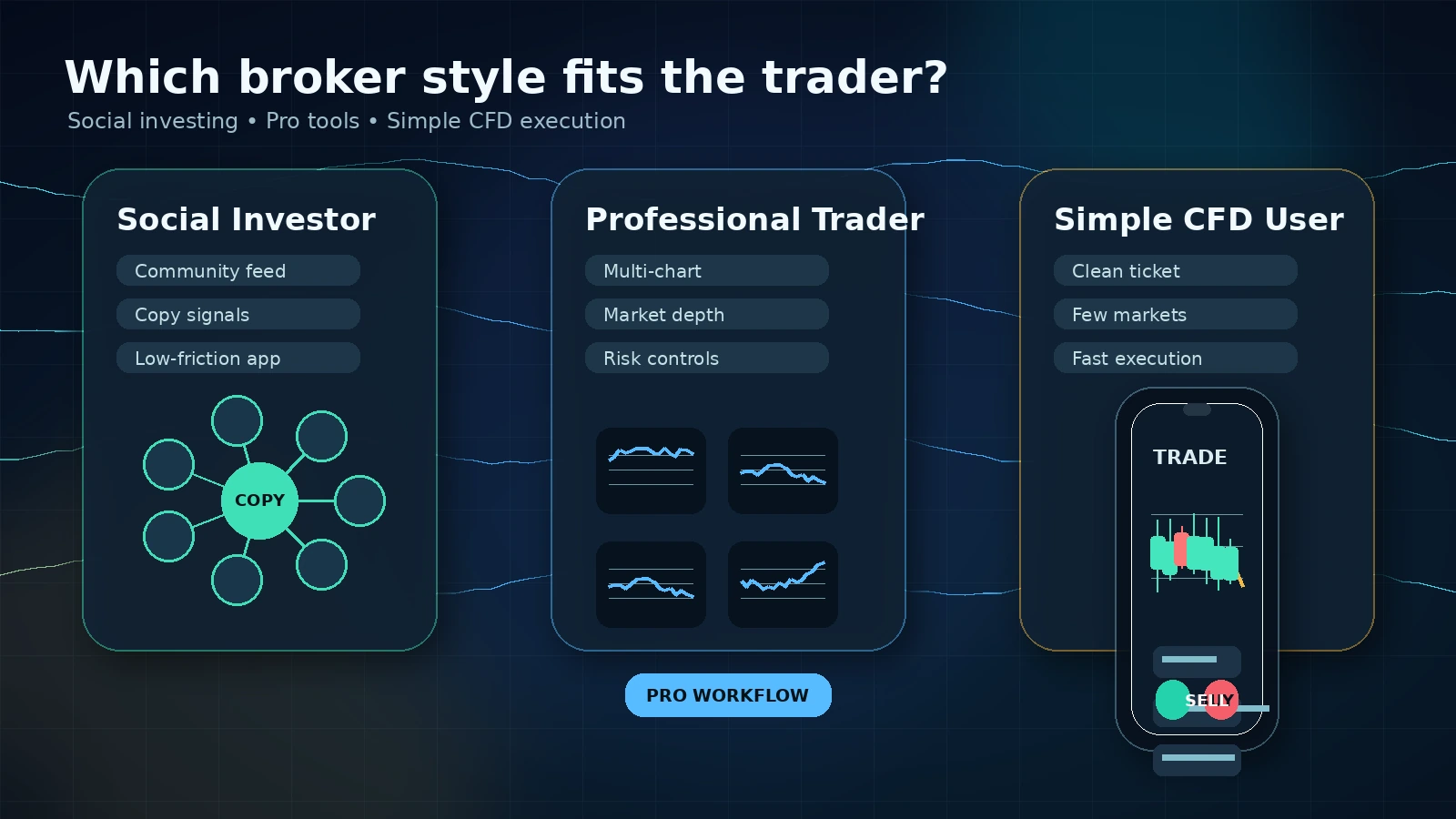
Who Should Choose Which
eToro is the right fit for social investors, absolute beginners, copy traders, and people who want real cryptocurrency ownership in the same account as their stock and CFD positions. The CopyTrader function genuinely lowers the barrier to entry for users who want exposure but lack the time or appetite to research individual positions. The trade-off is cost — eToro's 1.0 pip EUR/USD spread is roughly 65–80% more than IG's, and considerably more than any pure ECN broker.
IG is the right fit for experienced traders, UK investors who want a Stocks and Shares ISA wrapped around their share dealing, professional clients on a DMA setup, and anyone who wants the broadest possible product catalogue from a single regulated UK broker. The £250 minimum deposit is the highest of the three but not material for serious traders. IG also has a credible institutional offering for traders who graduate beyond retail size.
Plus500 is the right fit for casual CFD traders who want a clean, simple platform without complexity, and who do not need real stock ownership or copy trading. The product is honest about what it is. If your trading consists of occasional directional positions on a handful of indices and major FX pairs, Plus500's UX is genuinely pleasant. The short inactivity-fee window is the structural risk to be aware of.
None of the three are the right fit for active forex traders who want raw ECN spreads. eToro at 1.0 pip on EUR/USD is roughly three times the all-in cost of a tight ECN broker for any active trader doing more than a handful of trades per week. IG's standard spreads are competitive but its DMA tier is the only structurally lower-cost option, and that route is overkill for most retail FX traders. Plus500's variable spreads are the least competitive of the three on majors. For active forex, the better-suited alternatives are IC Markets, Fusion Markets, or Vantage.
The Verdict — And What the Comparison Sites Won't Tell You
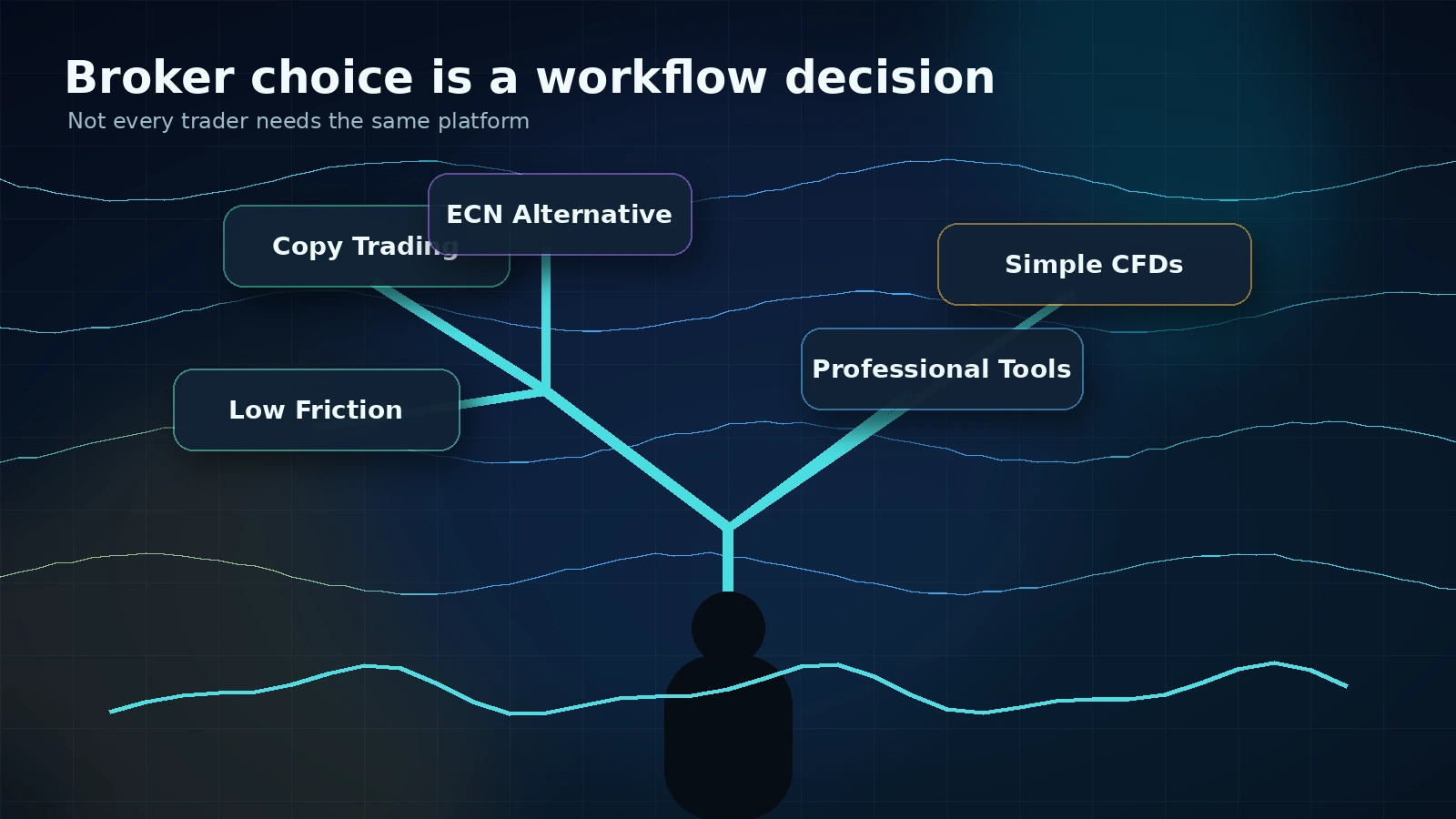
An honest assessment of the three: all three are safe, well-regulated brokers. None of them is the cheapest option for an active forex trader. The decision between them is a decision about what type of investor you are, not which one has the lowest fees in absolute terms.
The cost reality: a 1.0-pip EUR/USD spread on a single standard lot is roughly $10 of cost. The same trade through a raw-spread plus commission ECN broker — IC Markets at 0.0 pip plus $7 round-turn — costs around $3.50. The difference is 65%, and it compounds across every trade. For traders doing more than a few lots a week, this difference dwarfs the platform features being compared.
Where the three are unmatched: eToro for social and copy investing — there is no real competitor at scale. IG for UK regulated share dealing and ISA-wrapped investing — no other CFD broker offers the same product breadth. Plus500 for absolute simplicity — no other broker has built an interface this clean.
What to do: be honest about what you actually trade. If your account spends most of its time copying other portfolios or holding long-term equity positions, eToro or IG are good answers. If your account spends most of its time taking directional bets on FX and indices, neither eToro nor Plus500 are competitive on cost, and IG only at the DMA tier — a dedicated ECN broker will serve you better.
For active forex and CFD trading, our most-recommended alternatives are IC Markets for raw-spread ECN execution and Vantage for traders who also want copy trading. For full reviews of the three brokers compared in this article, see eToro, IG Group, and Plus500.
Risk warning. CFD trading involves significant risk and 74–89% of retail investor accounts lose money trading CFDs with the providers compared in this article. You should consider whether you understand how CFDs work and whether you can afford to take the high risk of losing your money. Past performance of copied portfolios is not indicative of future results. This article is informational and does not constitute financial advice.
📖 Key Terms — Forex Glossary
Not sure about a term?Browse our full Forex Glossary →
Frequently Asked Questions
Expert Answers to Common Queries