Best Brokers for Copy Trading 2026 — Platforms, Providers and Risk Explained
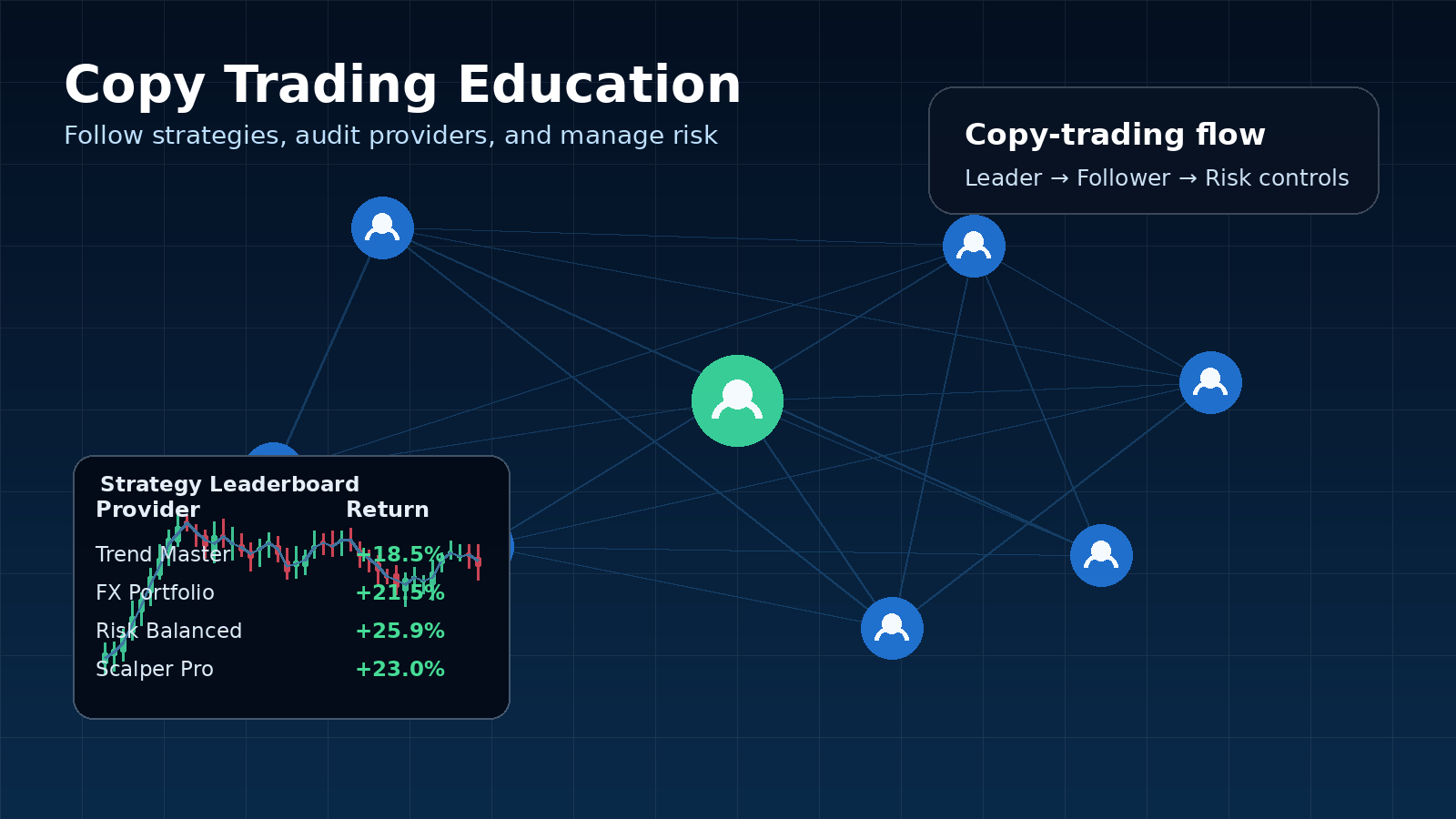
Copy trading lets retail investors automatically mirror the live positions of experienced strategy providers — without needing to analyse markets or execute trades manually. In 2026, regulated copy trading platforms are available under FCA, ASIC, and CySEC oversight, with mandatory risk disclosures and negative balance protection for retail clients. This guide explains how copy trading works mechanically, how to evaluate strategy providers using risk metrics, and which brokers and platforms offer the best regulated copy trading environments in 2026.
Written By
ForexRater Research Team
Data-driven broker comparison · Independently tested · No paid rankings
Reviewed against our published methodology →Reviews represent the editorial opinion of ForexRater and are not personal financial advice.
What Is Copy Trading? — How the Mechanics Work
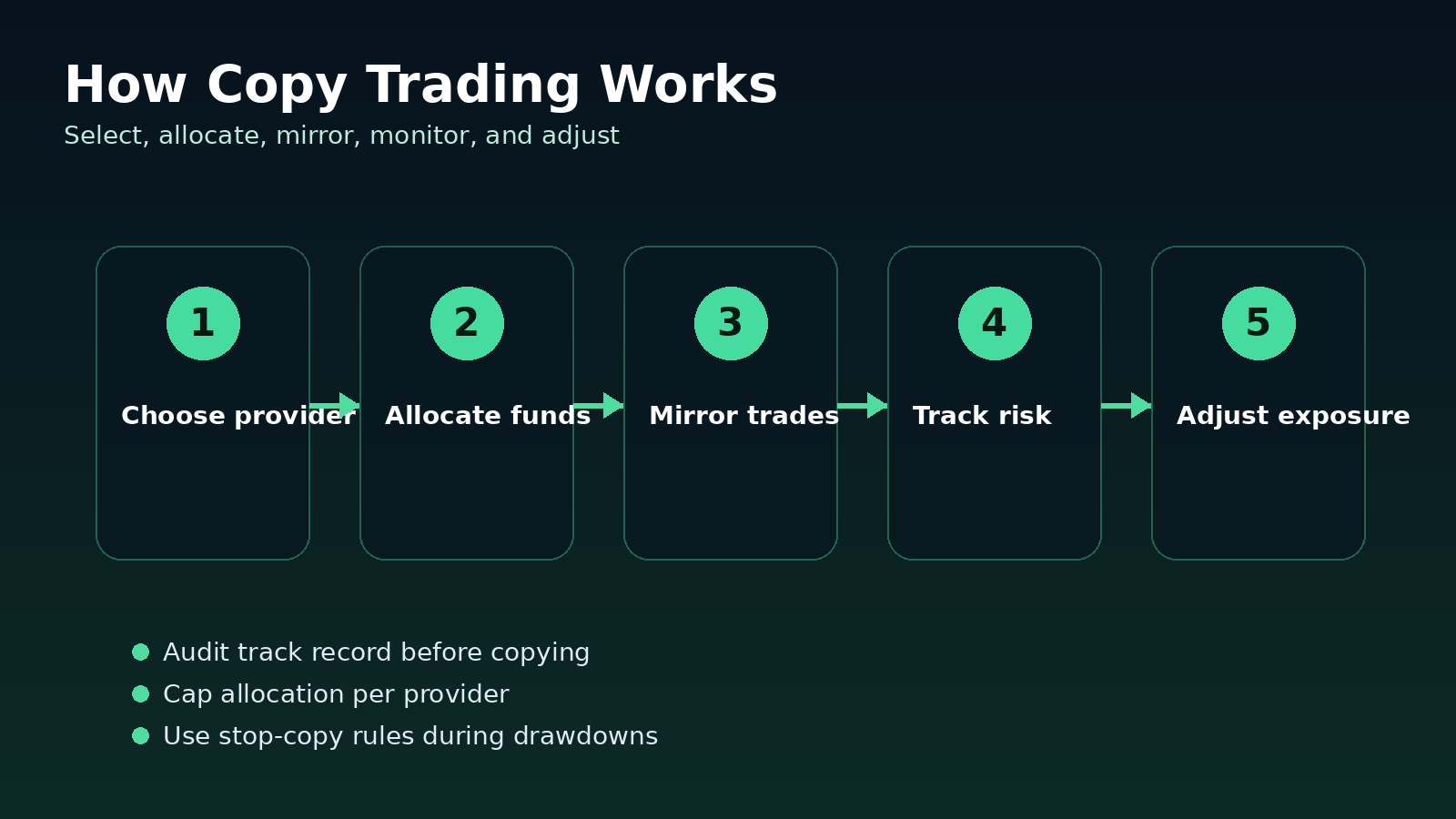
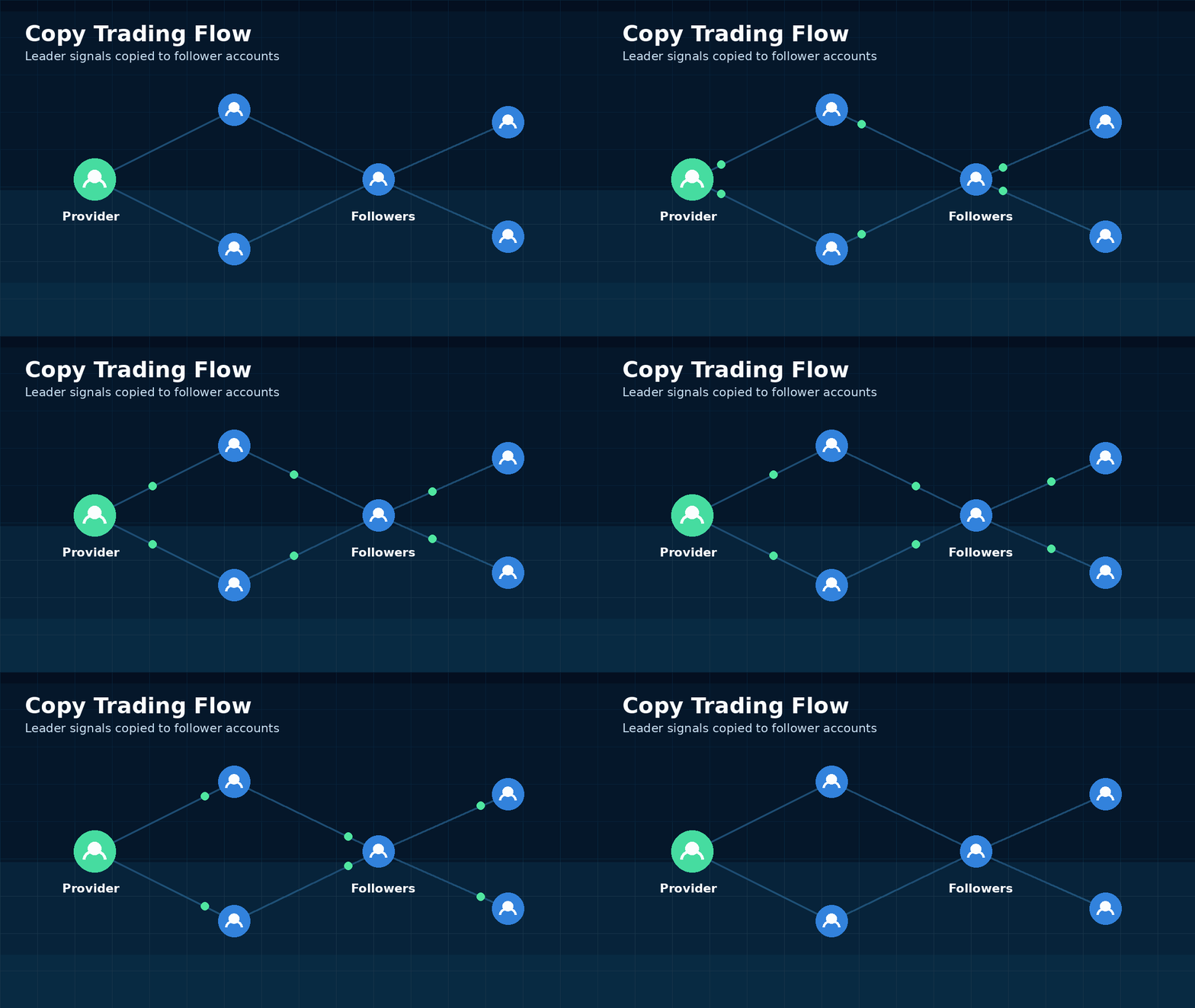
Copy trading is a form of social investing that allows retail traders to automatically replicate the positions of experienced strategy providers in real time. When a signal provider opens, modifies, or closes a trade, the identical action is mirrored across all connected follower accounts — proportionally scaled to the follower's allocated capital. The follower takes on real market exposure and real profit/loss; this is not paper trading or simulation.
The mechanics differ from signal services (which require manual execution) and managed accounts (where a third party trades directly in your account). In copy trading, the broker's infrastructure handles the replication automatically. The follower retains full control to pause copying, adjust allocation, or stop at any time — no power of attorney is granted to the strategy provider.
Strategy providers are typically compensated through a performance fee (a percentage of profits generated for followers), a subscription fee, or through spread mark-ups built into the platform. Reputable platforms publish real-time statistics for each provider: return on investment, maximum drawdown, risk score, trade frequency, average holding time, and asset mix. These metrics are essential due-diligence inputs — treat them as you would a fund manager's track record.
Choosing a Strategy Provider — Risk Metrics and Due Diligence
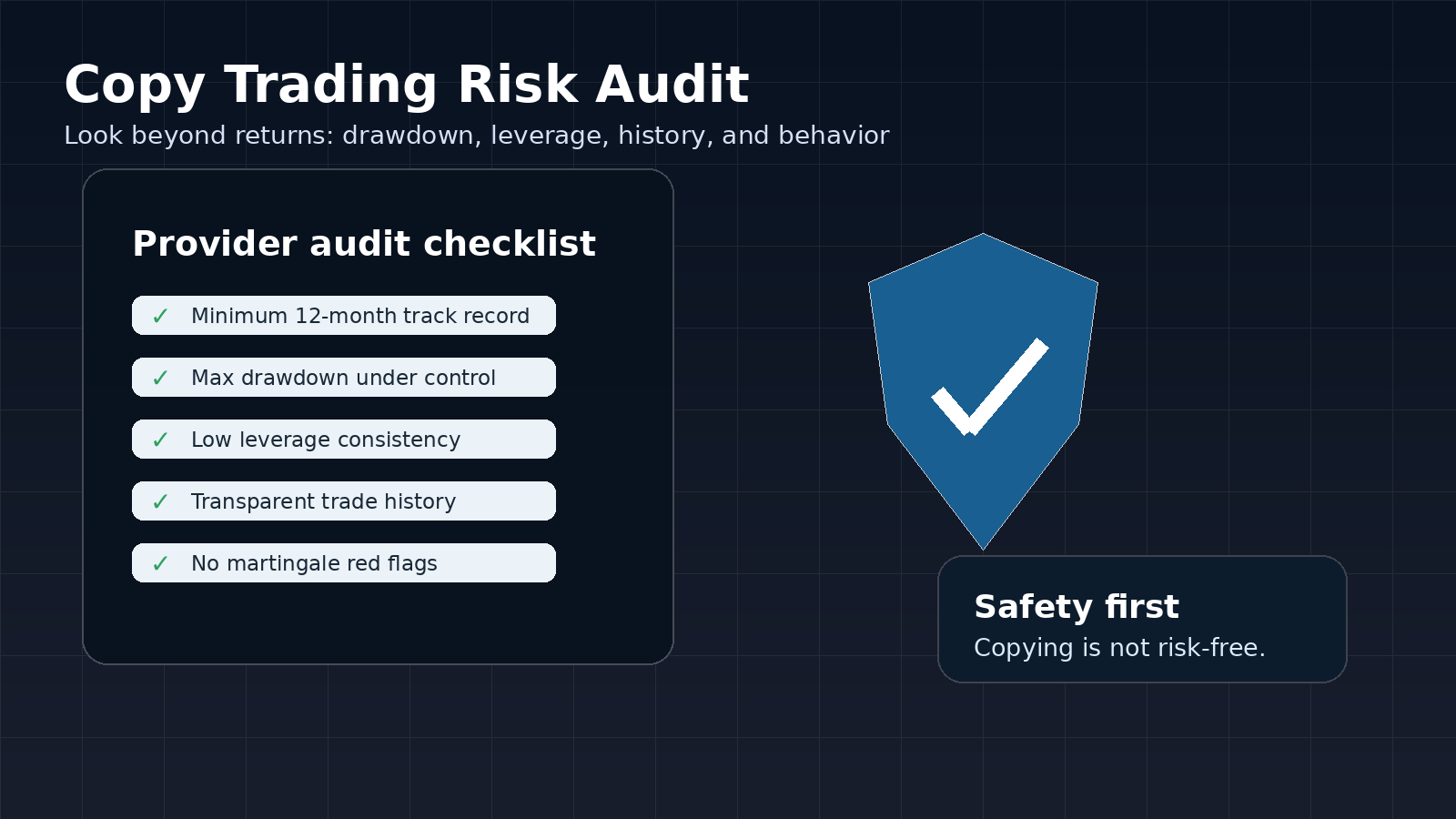
The most common error retail copy traders make is selecting providers based solely on recent return percentages. A provider showing 200% return over 6 months may have achieved this through extreme leverage, concentrated positions, or a strategy that coincided with a specific market regime. Due diligence requires evaluating the full risk-adjusted picture.
Maximum Drawdown: The largest peak-to-trough decline in the provider's equity curve. A drawdown above 30% on a leveraged account means followers could lose 30% or more of their allocated capital during the strategy's worst period. Compare drawdown to return — a provider making 40% with a 35% drawdown has a poor risk-reward profile. Look for drawdowns below 20% relative to the stated returns.
Sharpe Ratio: Return relative to volatility. A Sharpe Ratio above 1.0 indicates the provider is generating returns that adequately compensate for the risk taken. Below 0.5 suggests the strategy is not efficiently using risk. Most serious retail copy trading platforms (eToro, Vantage Copy) display this metric directly on provider profiles.
Trade History Length: Avoid providers with fewer than 6 months of live track record. Strategies that have only been running during bull markets or trending conditions may fail entirely in ranging or volatile environments. 12–18 months of live history across different market conditions is a more reliable indicator.
Asset Concentration: Providers trading only a single instrument (e.g., only BTC/USD or only EUR/USD) are more susceptible to regime changes. Diversified providers spread risk across multiple assets and reduce the impact of any single market event.
Best Brokers and Platforms for Copy Trading in 2026
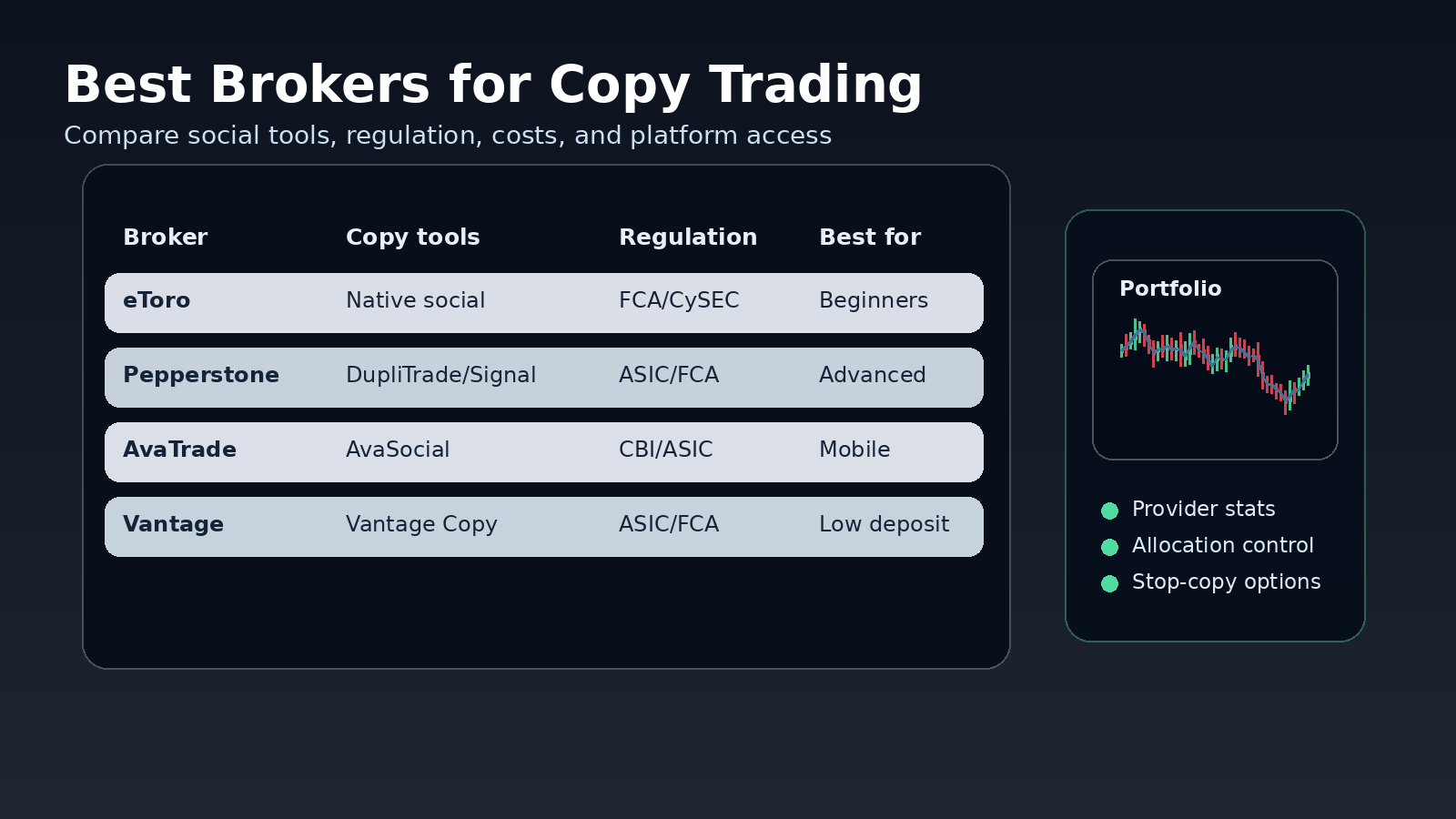
1. eToro — Largest Copy Trading Network Globally
eToro's CopyTrader is the world's largest copy trading platform with over 30 million registered users. It is regulated by the FCA (UK), CySEC (Cyprus), and ASIC (Australia). Strategy providers on eToro are real users of the platform whose live trades are visible and automatically copied. eToro offers copy trading across forex, stocks, ETFs, and crypto. The minimum copy amount is $200 per provider. eToro charges a spread mark-up (no separate commission) and a $5 withdrawal fee. Regulated status: FCA (FRN: 583263).
2. Vantage — Best ASIC-Regulated Copy Trading Option
Vantage's Vantage Copy platform allows followers to replicate signal providers across MT4 and MT5 accounts. Vantage is regulated by ASIC (Australia) and the FCA (UK, FRN: 590299). Strategy providers can set their own performance fees (typically 10–30% of profits). Vantage's raw ECN pricing applies to copied trades — followers benefit from the same tight spreads available to direct traders. Minimum copy amount: $50. This is the best option for traders who want copy trading on a true ECN broker with FCA/ASIC oversight.
3. ZuluTrade — Independent Signal Network (Multi-Broker)
ZuluTrade is a third-party copy trading network that connects to multiple regulated brokers including Alpari, ThinkMarkets, and IC Markets. It is regulated by HCMC (Greece) and operates as a signal aggregator rather than a broker. Followers can select from thousands of strategy providers and connect to their chosen underlying broker. ZuluTrade charges a mark-up on spread. Advanced filtering tools allow sorting providers by drawdown, profitability, and trade frequency across multiple time frames.
4. IC Markets — Best ECN Execution with Social Trading Integration
IC Markets supports copy trading through its integration with MetaTrader's Signal service and through third-party platforms including ZuluTrade and Myfxbook Autotrade. IC Markets is ASIC-regulated (ACN: 123 289 109) and offers the tightest ECN spreads of any major broker — ensuring copied trades are executed at optimal pricing without broker mark-ups. IC Markets does not have a proprietary copy trading interface but its superior execution quality makes it the preferred underlying broker for advanced copy traders.
Regulation, Risk Warnings, and What Copy Trading Cannot Promise
Copy trading platforms operating in the UK and EU are regulated under MiFID II as investment firms providing portfolio management services. FCA-regulated copy trading providers must disclose risk warnings on all promotional materials. In the EU and UK, regulated brokers must publish the percentage of retail CFD accounts that lose money — typically 74–89% across the industry. This figure applies equally to copy trading accounts.
Copy trading does not eliminate market risk. A follower mirroring a strategy that previously made 80% annual returns may experience very different outcomes if: the strategy provider's approach stops working in a changed market environment; the provider takes excessive risk in pursuit of performance fees; or the follower's account size creates slippage on copied trades relative to the provider's own account.
Be alert to conflict of interest: some platforms allow strategy providers to see their follower count in real time. A provider aware of large follower capital may be incentivised to take outsized risk for performance fees, knowing the downside is borne by followers. Platforms with blind follower counts or independent oversight reduce this risk.
All copy trading with leveraged CFDs involves the risk of losing more than the allocated copy amount if negative balance protection is not in place. FCA-regulated platforms provide mandatory negative balance protection for retail clients — ensuring losses are capped at deposited funds.
Best Brokers for Copy Trading 2026 — Platforms, Providers and Risk Explained Quiz
Test your understanding of the concepts covered in this masterclass.
1.What is the key difference between copy trading and a managed account?
2.Which metric best indicates whether a copy trading provider is efficiently managing risk?
3.Which copy trading platform is regulated by both the FCA and ASIC and uses a social network model?
4.What is the minimum copy amount per provider on eToro's CopyTrader platform?
📖 Key Terms — Forex Glossary
Not sure about a term?Browse our full Forex Glossary →
Frequently Asked Questions
Expert Answers to Common Queries
Is copy trading profitable?
Is copy trading legal in the UK?
What is the difference between copy trading and social trading?
How much capital do I need to start copy trading?
Can I copy trade on MetaTrader 4 or 5?
Research Methodology
Broker regulation verified against FCA, ASIC, CySEC, and HCMC public registers as of May 2026. Platform features and fee structures verified directly with each broker's published documentation. Risk metrics definitions sourced from FCA guidance on social trading. This article does not constitute investment advice — copy trading involves real risk of capital loss. Consult a regulated financial adviser before allocating capital.